
Glass furnace performance and campaign life depend heavily on the condition of the refractory lining. Among all furnace areas, the glass line—the transition zone between molten glass and the furnace atmosphere—is one of the most vulnerable to refractory degradation. Excessive wear in this area can lead to sidewall thinning, localized overheating, increased glass defects, and ultimately a shorter furnace campaign.
Unlike refractory sections that remain either fully submerged in molten glass or permanently exposed to the furnace atmosphere, the glass line is subjected to a unique combination of chemical corrosion, thermal cycling, alkali vapor attack, and mechanical abrasion. These overlapping mechanisms make it one of the fastest-wearing regions in most glass melting furnaces.
For furnace engineers, refractory specialists, and maintenance teams, understanding how glass line corrosion develops is essential for extending furnace service life, improving glass quality, and reducing unplanned maintenance. Although refractory wear is inevitable during long-term operation, deterioration at the glass line can be significantly reduced through appropriate refractory selection, stable furnace operation, and timely maintenance.
This article explains the mechanisms behind glass line corrosion, the operating conditions that accelerate refractory wear, and practical strategies for controlling degradation. It also compares different fused cast AZS blocks grades for glass line applications and outlines maintenance practices that help improve furnace reliability and extend campaign life.
1. What Is Glass Line Corrosion
Glass line corrosion refers to the progressive deterioration of refractory materials located at the interface between molten glass and the furnace atmosphere. In most regenerative and recuperative glass melting furnaces, this transition zone experiences more severe wear than adjacent refractory areas because it is continuously exposed to multiple forms of degradation.
Unlike the fully submerged sidewall, where corrosion is dominated by molten glass attack, or the furnace superstructure, where refractory wear is mainly caused by high-temperature gases and alkali vapors, the glass line is affected by both environments simultaneously. Molten glass, alkali vapors, temperature fluctuations, and glass movement all act together to accelerate refractory deterioration.
Typical signs of glass line corrosion include horizontal groove formation, surface recession, cracking, spalling, and gradual loss of refractory thickness. As wear progresses, detached refractory particles may enter the molten glass, increasing the risk of stones, inclusions, and other glass quality defects. If left uncontrolled, severe glass line corrosion can compromise sidewall integrity, increase heat loss, and shorten the overall furnace campaign.Because multiple degradation mechanisms interact in this area, glass line corrosion develops differently from wear in other parts of the furnace. Understanding these mechanisms is the first step toward selecting suitable refractory materials and implementing effective maintenance strategies.

2. Why Is the Glass Line the Most Vulnerable Area
The glass line is widely regarded as one of the most aggressive corrosion zones in a glass melting furnace. Unlike other refractory areas, it is exposed to molten glass, furnace atmosphere, alkali vapors, temperature fluctuations, and glass movement at the same time. These interacting conditions create a much more complex degradation environment than either the submerged sidewall or the furnace superstructure.
Rather than being caused by a single mechanism, glass line corrosion results from the combined effects of chemical attack, thermal fatigue, alkali vapor deposition, and mechanical erosion. Each mechanism accelerates the others, leading to faster refractory wear and making the transition zone one of the most difficult areas to protect during long-term furnace operation.
2.1 Chemical Corrosion by Molten Glass and Alkalis
Chemical attack is the primary mechanism responsible for long-term refractory wear at the glass line. Most commercial glass compositions, particularly soda-lime glass, contain alkali oxides such as Na₂O and K₂O, which readily react with refractory materials at elevated temperatures.
When molten glass comes into contact with fused cast AZS blocks, chemical reactions gradually consume the glassy phase within the refractory microstructure. As this reaction layer develops, alumina and zirconia crystals become progressively exposed and more susceptible to dissolution and mechanical removal. Over time, the refractory surface recedes, reducing sidewall thickness and weakening structural integrity.
At the glass line, this process becomes even more aggressive because the refractory is alternately exposed to molten glass and the furnace atmosphere. Repeated wetting and drying promote deeper penetration of corrosive species than in permanently submerged areas, resulting in the characteristic horizontal grooves commonly observed during furnace inspections.
2.2 Thermal Cycling and Fatigue
The glass line is also subjected to continuous thermal cycling as the molten glass level changes during normal furnace operation. Variations in pull rate, furnace temperature, charging conditions, and production adjustments can all cause the glass level to fluctuate.
When the glass level rises, the refractory is heated by direct contact with molten glass. As the level falls, the same area is exposed to the comparatively cooler furnace atmosphere. These repeated temperature changes generate cyclic expansion and contraction within the refractory, producing thermal stresses that accumulate over time.
As fatigue progresses, micro-cracks begin to form and gradually propagate into larger cracks. Once cracking occurs, molten glass and alkali vapors can penetrate deeper into the refractory, accelerating chemical attack and increasing the likelihood of surface spalling. This interaction between thermal fatigue and chemical corrosion is one of the main reasons why glass line wear progresses more rapidly than corrosion in permanently submerged refractory zones.
2.3 Alkali Vapor Condensation
Alkali vapor attack is another characteristic feature of glass line corrosion. During glass melting, part of the alkali contained in the batch volatilizes and rises with the high-temperature furnace gases. As these vapors approach the relatively cooler region near the glass surface, they begin to condense on adjacent refractory surfaces.
.png)
The condensed alkali compounds react with the refractory, gradually altering its microstructure and forming low-melting reaction products. These reactions weaken the bonding between crystalline phases, reduce surface strength, and make the refractory more susceptible to subsequent chemical and mechanical attack.
Because alkali vapor condensation occurs repeatedly throughout furnace operation, a highly reactive layer develops around the glass line. Combined with periodic contact from molten glass, this process continuously removes weakened surface material and contributes to the gradual formation of horizontal grooves along the sidewall.
2.4 Mechanical Erosion Caused by Glass Movement
Mechanical erosion works together with chemical corrosion by removing weakened refractory material and exposing fresh surfaces to further attack. Although chemical reactions initiate the degradation process, continuous glass movement prevents the formation of a stable protective reaction layer.
Molten glass is constantly in motion due to natural convection currents, production pulling, and bubbling systems. Flow velocity is generally higher near the glass surface than in deeper regions, creating stronger scouring action along the glass line.
Where bubbling systems are installed, rising gas bubbles generate additional turbulence as they reach the glass surface. Although the impact of individual bubbles is relatively small, continuous turbulence over thousands of operating hours gradually removes reaction products and loosened refractory grains. This ongoing mechanical abrasion continuously exposes fresh refractory material, allowing chemical corrosion to proceed without interruption.
2.5 Common Signs of Glass Line Corrosion
Glass line corrosion usually develops gradually rather than appearing as a sudden failure. Regular inspections allow furnace engineers to identify early signs of deterioration before significant refractory loss affects furnace performance or glass quality. Because several degradation mechanisms often occur simultaneously, multiple symptoms are typically observed at the same location.
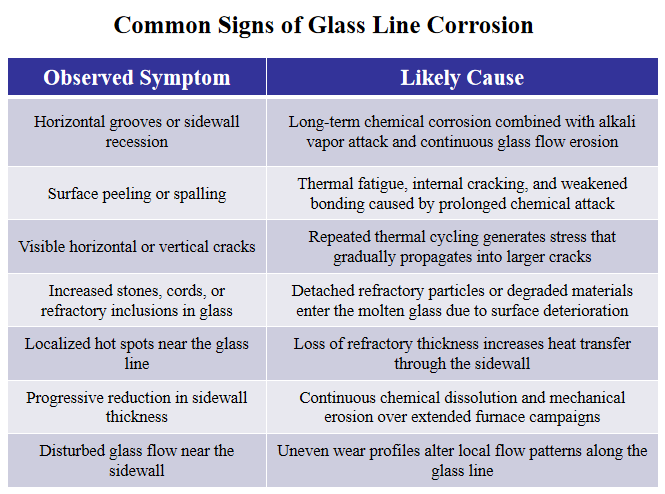
In practice, these symptoms rarely occur independently. Horizontal grooving is often accompanied by surface cracking or spalling, while increasing glass defects may indicate that refractory particles are entering the melt. Localized hot spots typically suggest more advanced wear and should prompt a detailed inspection of the affected sidewall area.
3. Factors That Accelerate Glass Line Corrosion
The severity of glass line corrosion depends not only on refractory quality but also on furnace operating conditions. In many cases, premature wear is driven by unstable process control rather than by the refractory material itself. Maintaining stable operating parameters is therefore essential for maximizing refractory service life and extending the overall furnace campaign.
3.1 Elevated Furnace Temperature
Higher operating temperatures accelerate nearly all corrosion mechanisms. As temperature increases, chemical reactions between molten glass and refractory materials proceed more rapidly, while alkali volatilization also becomes more pronounced. The resulting increase in alkali vapor concentration intensifies vapor condensation around the glass line, further accelerating refractory degradation.
3.2 High Pull Rate and Strong Glass Flow
Higher production pull rates increase glass velocity and turbulence near the molten glass surface. Faster flow continuously removes weakened reaction layers from the refractory surface, exposing fresh material to further chemical attack. Frequent production adjustments may also cause glass level fluctuations, increasing thermal cycling at the transition zone.
3.3 Glass Composition
Glass chemistry has a direct influence on corrosion intensity. Glasses containing higher concentrations of alkali oxides generally create a more aggressive environment for refractory materials. Soda-lime container glass, for example, typically produces stronger alkali vapor attack than many specialty low-alkali glass formulations. Depending on the glass composition and furnace operating conditions, float glass, solar glass, and certain specialty glasses may also impose demanding corrosion conditions on the glass line.
3.4 Furnace Atmosphere
Maintaining a stable furnace atmosphere is important for long-term refractory performance. Excessively reducing conditions may alter melt chemistry and increase the aggressiveness of the glass-refractory interface. In contrast, a well-controlled, slightly oxidizing atmosphere generally supports more stable operating conditions and helps minimize unnecessary refractory deterioration.
3.5 Glass Level Fluctuation
Frequent changes in molten glass level expand the area subjected to alternating heating and cooling. This repeated thermal cycling accelerates crack formation and allows corrosive species to penetrate deeper into the refractory structure. Stable glass level control is therefore one of the most effective operational measures for reducing long-term glass line wear.
4. Best Refractory Materials for Glass Line Applications
Selecting the appropriate refractory material is one of the most effective ways to control glass line corrosion. Because the transition zone is simultaneously exposed to molten glass, alkali vapors, thermal cycling, and mechanical erosion, the refractory must provide excellent resistance to multiple degradation mechanisms rather than a single type of attack.
Among the various refractory materials used in glass furnaces, fused cast AZS block remains the industry standard for glass line applications. Its unique microstructure combines high corrosion resistance with good thermal stability, making it well suited for prolonged service under demanding furnace conditions.
Different AZS grades contain different zirconia contents, resulting in varying levels of corrosion resistance and service performance. Selecting the appropriate grade should be based on furnace design, glass composition, operating conditions, and the expected severity of corrosion.
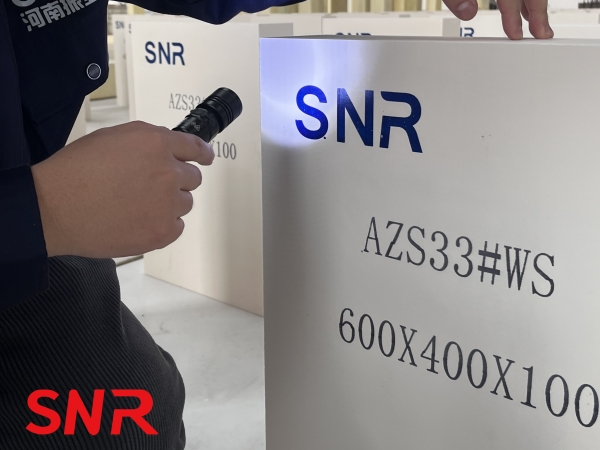
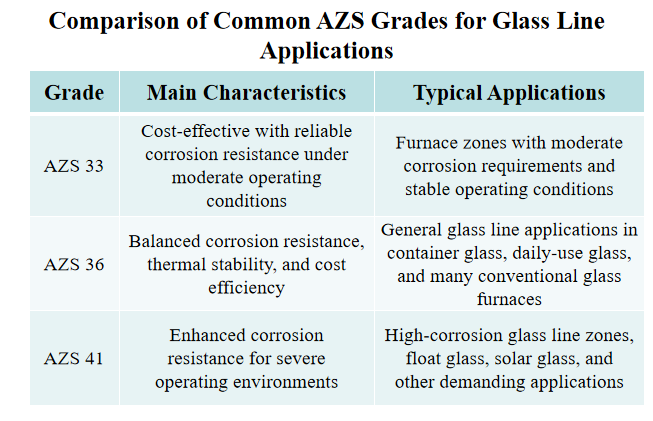
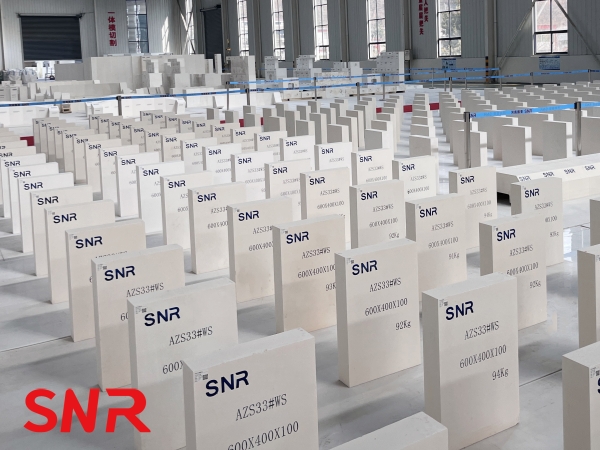
AZS 33
AZS 33 is a cost-effective solution for furnace areas exposed to moderate corrosion conditions. It provides reliable resistance to molten glass attack under stable operating conditions and is widely used in glass furnaces where alkali vapor concentration and thermal fluctuations are relatively limited.
When properly applied, AZS 33 offers dependable service life while helping control refractory investment costs. It is often selected for furnace zones where corrosion demands are moderate rather than extreme.
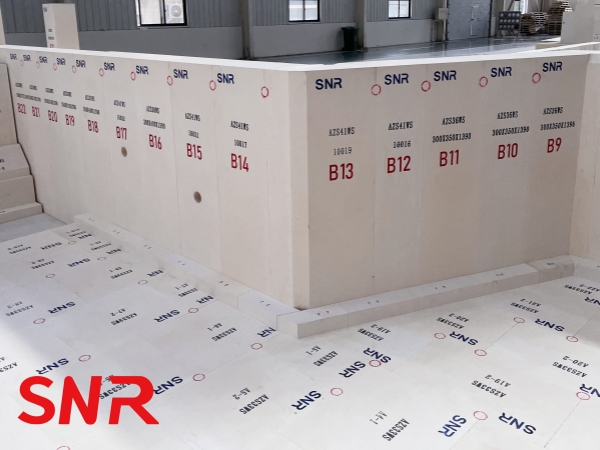
AZS 36
AZS 36 is the most widely used fused cast AZS grade for glass furnace applications because it offers an excellent balance between corrosion resistance, thermal stability, and cost efficiency.
Compared with AZS 33, its higher zirconia content provides improved resistance to molten glass corrosion and alkali vapor attack while maintaining good resistance to thermal shock and structural degradation. For many container glass, daily-use glass, and general glass melting furnaces, AZS 36 is considered the preferred choice for glass line applications.
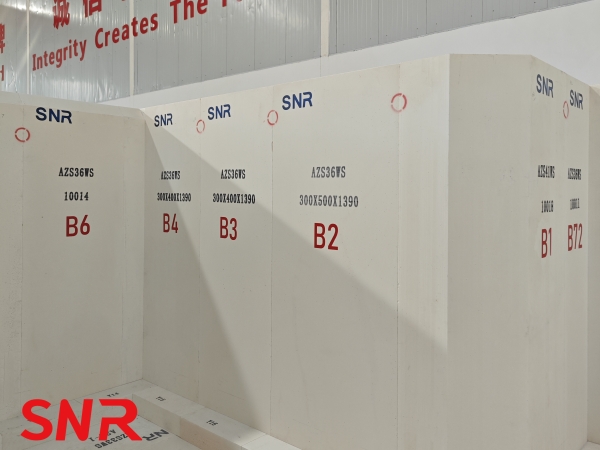
AZS 41
AZS 41 is designed for furnace zones exposed to the most severe corrosion conditions. Its higher zirconia content significantly improves resistance to aggressive molten glass, alkali vapor attack, and prolonged high-temperature service.
This grade is frequently selected for demanding applications such as float glass, solar glass, and other furnaces processing highly corrosive glass compositions. In critical wear zones where extended campaign life is a priority, AZS 41 can help reduce refractory consumption, minimize maintenance requirements, and improve long-term operational reliability.
Although AZS 41 generally requires a higher initial investment, its longer service life often contributes to lower maintenance costs and reduced furnace downtime in severe operating environments.
Comparison of Common AZS Grades
5. Practical Ways to Reduce Glass Line Corrosion
Although glass line corrosion cannot be completely eliminated during normal furnace operation, its progression can be significantly slowed through appropriate refractory selection, stable operating practices, and proactive maintenance. A combination of sound engineering design and disciplined process control is the most effective approach to extending refractory service life.
5.1 Select the Appropriate AZS Grade
Refractory selection should be based on the actual operating conditions of the furnace rather than applying a single material throughout all glass line areas. Factors such as glass composition, alkali content, operating temperature, production rate, and the desired furnace campaign should all be considered.
♦ AZS 33 – Recommended for moderate corrosion environments.
♦ AZS 36 – The preferred choice for most conventional glass furnace operating conditions, offering a balanced combination of corrosion resistance, thermal stability, and cost efficiency.
♦ AZS 41 – Recommended for the most severe corrosion environments, where maximum resistance to molten glass and alkali attack is required.
5.2 Maintain a Stable Glass Level
Minimizing fluctuations in the molten glass level helps reduce thermal cycling across the glass line. Stable operating levels also limit repeated wetting and drying of the refractory surface, slowing the development of thermal fatigue and chemical attack.
Accurate level-control systems and consistent production management play an important role in maintaining long-term refractory stability.
5.3 Avoid Excessive Operating Temperatures
Operating above the required melting temperature accelerates both chemical corrosion and alkali volatilization. Maintaining the furnace within its designed temperature range helps reduce unnecessary refractory wear while improving energy efficiency and process stability.
5.4 Reduce Frequent Process Adjustments
Large or frequent changes in pull rate, furnace temperature, or firing conditions introduce additional thermal stresses throughout the transition zone. Whenever production requirements allow, maintaining stable operating parameters helps minimize cyclic loading on the refractory and slows long-term deterioration.
5.5 Maintain a Stable Furnace Atmosphere
A well-controlled furnace atmosphere contributes to more stable glass chemistry and helps reduce unnecessary corrosion at the glass-refractory interface. Avoiding prolonged reducing conditions can also improve the long-term stability of refractory materials.
5.6 Establish Routine Monitoring
Regular inspections allow maintenance teams to identify abnormal wear before significant damage occurs. Typical monitoring methods include:
♦ Visual inspection of the glass line
♦ Infrared thermography for hot spot detection
♦ Sidewall thickness measurements
♦ Long-term wear trend analysis
♦ Early detection enables timely maintenance and reduces the risk of unexpected refractory failure.
5.7 Repair Local Damage Before It Progresses
Once localized cracking, spalling, or excessive grooving is identified, appropriate maintenance should be scheduled before deterioration spreads to surrounding refractory blocks. Early intervention is generally more economical than extensive repairs after severe sidewall wear has developed.
6. Glass Line Corrosion vs. Other Furnace Corrosion
Different areas of a glass furnace operate under different thermal, chemical, and mechanical conditions. As a result, each zone exhibits its own characteristic corrosion mechanisms and requires refractory materials suited to its specific service environment.
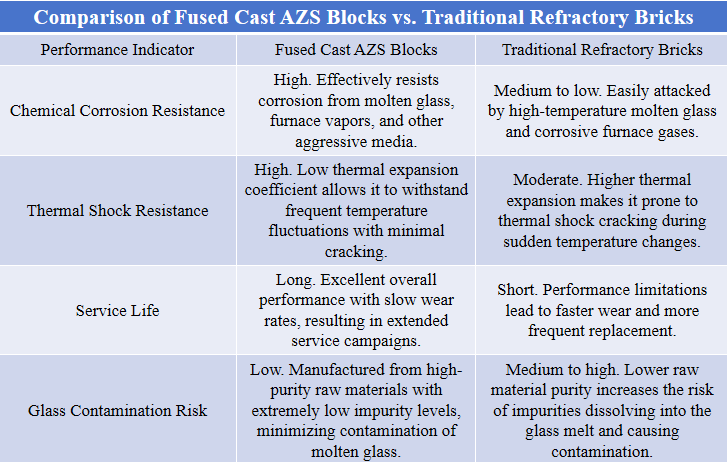
The glass line is unique because it experiences all major degradation mechanisms simultaneously. While other furnace zones are typically dominated by one or two primary corrosion modes, the transition zone is subjected to continuous interaction between molten glass, furnace atmosphere, alkali vapors, temperature fluctuations, and glass movement.
This combination makes the glass line one of the most demanding environments for refractory materials and explains why appropriate material selection and stable furnace operation are particularly important in this area.
Conclusion
Glass line corrosion is one of the most critical factors affecting refractory service life in glass melting furnaces. Because this transition zone is simultaneously exposed to molten glass, alkali vapors, thermal cycling, and mechanical erosion, its degradation is generally more severe than that of other furnace areas.
Although glass line corrosion cannot be completely eliminated, its progression can be effectively controlled through appropriate refractory selection, stable furnace operation, and regular condition monitoring. Choosing the right fused cast AZS block grade for the actual operating environment helps reduce refractory wear, maintain glass quality, and support longer furnace campaigns.
For glass manufacturers, successful glass line management is not simply about selecting a higher-grade refractory—it is about matching material performance with furnace operating conditions and implementing consistent maintenance practices throughout the furnace campaign.
About SNR
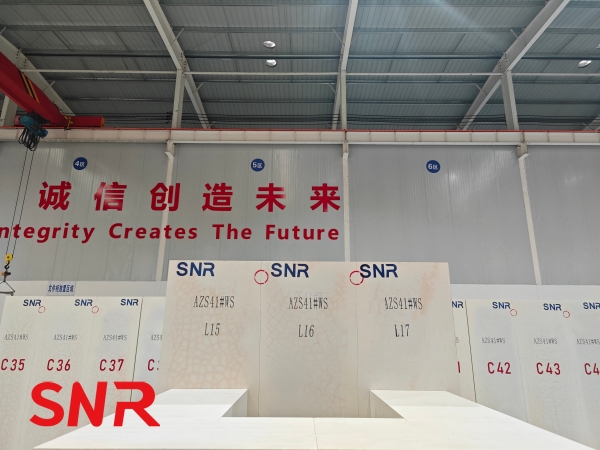
Henan SNR Refractory Co., Ltd. specializes in the production of fused cast refractory materials for glass melting furnaces. With more than 20 years of manufacturing experience, SNR supplies AZS 33, AZS 36, AZS 41, fused cast alumina blocks, zircon products, and other refractory solutions for container glass, float glass, solar glass, and specialty glass applications.
Our engineering team works closely with customers to recommend suitable refractory materials based on furnace design, glass composition, and operating conditions, helping improve furnace reliability and extend campaign life.
Contact SNR for professional fused cast AZS block solutions
 Email: [email protected]
