
In glass furnace operation and refractory maintenance, the performance stability of furnace linings directly affects furnace campaign life, finished glass quality, and overall production costs. Unlike common industrial refractory materials, glass furnace linings endure long-term combined damage from high-temperature molten glass erosion, alkaline vapor corrosion, cyclic thermal shock, and mechanical scouring during continuous production. Among mainstream refractory materials, fused cast AZS blocks stand out as the preferred lining option for medium and large-scale glass furnaces, thanks to their compact casting structure, reliable high-temperature performance, and excellent resistance to molten glass infiltration.
For glass furnace engineers, refractory technicians, and procurement professionals, graded selection of AZS refractory grades (AZS 33, AZS 36, AZS 41) and targeted zoning installation for critical areas such as glass lines and furnace throats are key to refractory system optimization. Most common lining problems, including gradual surface peeling, persistent glass strip defects, and local premature erosion, typically stem from mismatched material grading and unreasonable zoning design, rather than conventional high-temperature aging. Based on years of on-site experience in glass furnace lining design, overhaul supervision, and application technical guidance, this paper analyzes the graded performance differences, working condition matching principles, and field application best practices of fused cast AZS blocks, providing practical engineering references for technical design and cost-effective refractory procurement.
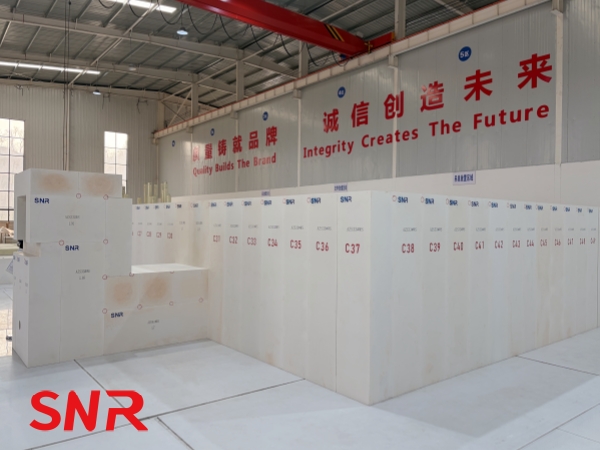
1. Basic Performance Advantages of Fused Cast AZS Refractory for Glass Furnaces
Fused cast AZS refractory is produced through electric melting and integral casting, with alumina, zirconia, and silica as core raw materials. Compared with traditional sintered bricks, clay bricks, and ordinary high-alumina bricks widely used in early glass furnaces, fused cast AZS materials feature a compact integral casting structure and low apparent porosity, which can adapt to the complex and extreme service environment of glass melting furnaces, making them the dominant refractory lining material in modern industrial glass production.
The electric melting and integral casting process eliminates interconnected open pores prevalent in sintered refractories, delivering low apparent porosity and high bulk density. This compact structural characteristic greatly reduces the penetration channels for high-temperature molten glass and alkaline volatile substances. Under long-term operating temperatures above 1500℃, molten glass and alkali vapors barely penetrate the brick interior, effectively mitigating structural loosening, layer separation, and internal corrosion progression that frequently occur in ordinary refractory linings.
Zirconia, the core functional component of AZS materials, delivers excellent anti-corrosion capability against glass line erosion, which is the most complex and destructive corrosion form in glass furnaces. The glass line zone bears multi-layer alternating damage: high-temperature flue gas and alkaline vapor corrosion in the upper section, gas-liquid alternating thermal stress in the middle junction, and static molten glass immersion in the lower section. Zirconia can enhance the overall erosion resistance and structural stability under thermal stress, while forming a uniform viscous protective layer on the contact surface with molten glass, which steadily slows down the continuous erosion of furnace linings.
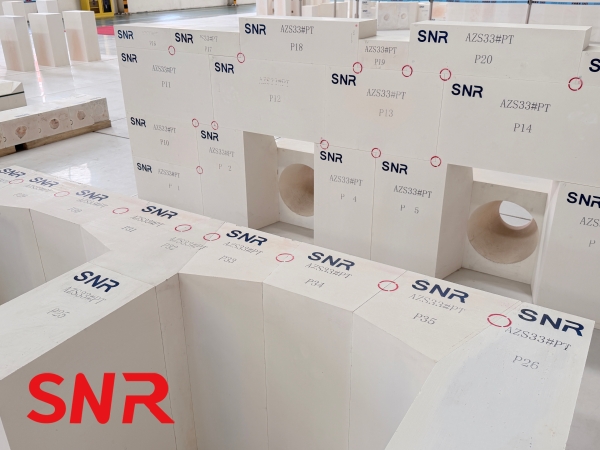
In addition, fused cast AZS blocks maintain stable high-temperature mechanical strength and creep resistance under long-term furnace load, avoiding irreversible deformation, cracking, and structural failure. They also provide reliable tolerance to alkaline vapor corrosion against sodium and potassium volatiles released from glass batches, preventing alkali-induced expansion, cracking, and powder shedding of lining bricks.
In industrial applications, zirconia content serves as the core indicator to distinguish the performance of AZS 33, AZS 36, and AZS 41 grades. Each grade corresponds to unique working condition tolerance and applicable boundaries, forming the basic basis for engineering graded selection. It is worth emphasizing that in glass furnace refractory design, the most suitable refractory materials always match the actual service conditions, rather than simply adopting higher-grade products blindly.

2. Core Performance Differences and Working Condition Adaptation of AZS 33, AZS 36 and AZS 41 Grades
In daily glass furnace engineering design and refractory procurement, unreasonable AZS grade matching often leads to inefficient furnace operation and cost waste. Blindly applying high-zirconium AZS grades in low-corrosion zones cannot effectively extend furnace service life, while using low-grade AZS materials in severe corrosion critical areas will accelerate lining wear. Combined with long-term on-site operating data of float glass, container glass, and borosilicate glass furnaces, this section systematically sorts out the performance characteristics and applicable scenarios of three mainstream AZS grades.
2.1 Fused Cast AZS 33 Block: Cost-Effective Solution for Low-Corrosion, Temperature-Fluctuation Zones
Fused cast AZS 33 block has a nominal zirconia content of 33%, with well-balanced alumina-silica matrix components. As the most economical grade in the fused cast AZS product series, it is designed to maintain stable performance under mild corrosion and frequent temperature fluctuation conditions.
Field application data verifies that AZS 33 presents excellent thermal shock resistance and structural stability at operating temperatures ranging from 1400℃ to 1500℃. Its low thermal expansion coefficient allows it to withstand regular furnace temperature fluctuations without obvious cracking or peeling. However, its resistance to high-temperature molten glass scouring and concentrated alkaline vapor corrosion is relatively limited. Under high-temperature, high-alkali, and high-flow scouring environments, its anti-erosion performance cannot support long-term stable furnace operation. For this reason, AZS 33 is generally not recommended for glass line areas and furnace throat zones with severe corrosion and strong scouring conditions.
.JPG)
.png)
In practical furnace zoning design, AZS 33 is commonly applied in low-corrosion auxiliary zones, including furnace upper structures, secondary lining layers, and flue channels. For small and medium-sized container glass furnaces with stable batch formulas, low alkali content, and fixed operating parameters, AZS 33 can be used for static lower sidewall areas with negligible glass scouring. This matching method ensures basic service performance while optimizing the overall investment cost of refractory materials.
2.2 Fused Cast AZS 36 Block: Balanced Grade for Conventional Critical Zones (Industry Mainstream)
Fused cast AZS 36 block features a standard zirconia content of 36%, acting as an upgraded and balanced version of AZS 33. On the premise of retaining reliable thermal shock resistance, it optimizes the microscopic phase ratio of the brick body, significantly improving resistance to molten glass penetration and high-temperature creep resistance, and achieves the optimal balance between performance and cost for conventional glass furnace working conditions.
Compared with AZS 33, AZS 36 has a more compact casting structure and fewer internal micro-pores, providing stronger tolerance to soda-lime glass infiltration and medium-intensity molten glass scouring. Under stable operating temperatures of 1500℃ to 1550℃, the mainstream temperature range for float glass and daily-use container glass production, AZS 36 can steadily form a uniform protective glaze layer in gas-liquid alternating glass line zones, restrain progressive erosion, and avoid groove-type wear and brick peeling defects.
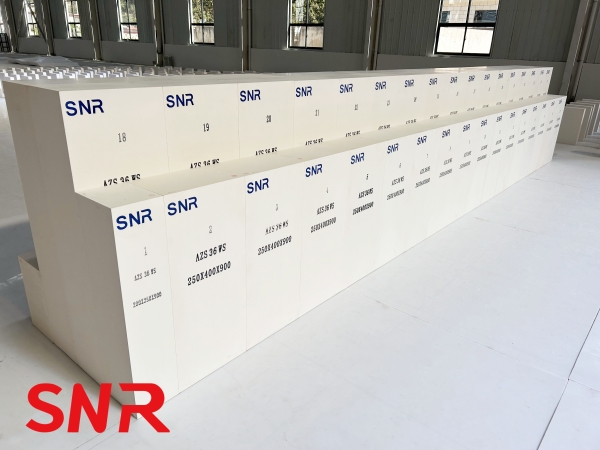
At present, AZS 36 is the universal mainstream material for key conventional zones of most industrial glass furnaces. It is typically suitable for standard glass line zones, upper furnace bottom linings, and medium-scour side wall areas of float glass and ordinary container glass furnaces. For medium-sized furnaces with stable batch components, fixed temperature fields, and continuous production modes, AZS 36 is widely adopted in medium and long campaign life furnace designs, serving as the preferred graded solution for most conventional critical refractory zones.
2.3 Fused Cast AZS 41 Block: High-Performance Grade for High-Temperature, High-Corrosion, High-Scour Zones
Fused cast AZS 41 block has the highest zirconia content (41%) among conventional AZS grades, with an ultra-compact integral casting structure. It is specially developed for extreme service conditions involving high temperature, intense molten glass scouring, and high-concentration alkaline vapor corrosion, which are commonly found in large industrial glass furnaces and special glass production lines.
Benefiting from its high zirconia ratio and optimized phase composition, AZS 41 delivers superior anti-corrosion and anti-scouring performance under severe operating conditions. In high-temperature environments of 1550℃ to 1600℃, such as borosilicate glass melting zones and throat zones of high-yield float glass furnaces, it can effectively resist rapid molten glass scouring and intensive alternating corrosion of high-concentration alkali volatiles, slow down local lining thinning, and extend the service life of core critical zones.
.jpg)
Different from low and medium-grade AZS materials, the high zirconia content and ultra-compact structure of AZS 41 bring higher requirements for field application. This grade features outstanding high-temperature structural stability and minimal creep deformation under long-term extreme load, but it has relatively sensitive thermal shock tolerance compared with AZS 33 and AZS 36. To fully exert its excellent anti-corrosion advantages, AZS 41 zones require more precise furnace baking curves, standardized masonry construction, and stable long-term operation; frequent temperature fluctuations may induce internal micro-cracks and weaken its service performance.
In engineering practice, AZS 41 is recommended for severe working conditions, mainly applied to furnace throat linings, high-risk glass line erosion points of large float glass furnaces, doghouse surroundings, and high-scour furnace bottom zones. These core areas bear the most intense molten glass impact and composite corrosion in the entire furnace, and the application of AZS 41 can support long-term stable furnace operation and avoid local premature failure that restricts overall campaign life.
3. Key Application Scenarios & Zoning Selection Logic of Fused Cast AZS Blocks
Professional glass furnace refractory design follows the core principle of "zoned matching based on working conditions". Different glass types create differentiated corrosion environments: soda-lime float glass produces high alkali volatility with stable molten glass flow; container glass features moderate temperature and conventional scouring intensity; borosilicate glass requires higher melting temperatures and causes special composite corrosion. Adopting unified single-grade materials for the entire furnace may lead to either excessive cost investment or insufficient local anti-corrosion capability. Combined with multi-industry furnace operation experience, the targeted graded selection logic for key furnace zones is summarized as follows.
3.1 Glass Line Area: Core Anti-Corrosion Zoning Based on Glass Type & Temperature
The glass line zone is one of the most critical and vulnerable parts of furnace linings, and persistent glass line corrosion is a major factor leading to shortened furnace campaign life. This zone suffers from three-dimensional composite damage: static molten glass immersion and scouring in the lower section, gas-liquid alternating thermal stress at the middle junction, and high-temperature alkaline flue gas corrosion in the upper section. Corrosion intensity varies greatly with glass formulas and melting temperatures.
Selection logic: For conventional container glass furnaces and small and medium-sized soda-lime glass furnaces with operating temperatures below 1500℃ and stable low-alkali batches, AZS 36 is the most reliable and cost-effective option, which can fully adapt to conventional glass line corrosion and meet standard design service life requirements. For large float glass furnaces with high-alkali batches, high-yield continuous production, and operating temperatures above 1550℃, as well as high-temperature borosilicate glass furnaces, intensified alkali volatilization and molten glass activity will aggravate glass line wear, where AZS 41 is recommended for local reinforcement. AZS 33 is generally not used for main glass line zones due to its limited resistance to long-term gas-liquid alternating erosion.
3.2 Throat Area: High-Scour Zone Requiring High-Grade Refractory Matching
The furnace throat serves as the only flow channel for molten glass to transfer from the melting pool to the clarification pool. Refractory linings in throat areas withstand the strongest molten glass scouring and flow impact in the entire furnace system. High-speed and high-turbulence molten glass continuously scours the lining, coupled with concentrated alkaline vapor corrosion and thermal stress concentration. Slight local lining wear may cause unstable molten glass flow fields, induce glass stripe defects, and even lead to unplanned shutdown maintenance in serious cases.
Selection logic: The furnace throat is a typical high-scour and high-risk zone, where anti-corrosion and anti-scouring performance take priority over cost control. For most large and medium-sized continuous production industrial glass furnaces, AZS 41 is the standard matching grade, which maintains long-term dimensional stability of throat linings and consistent molten glass flow fields. For small intermittent experimental furnaces and low-yield small-batch production lines with low molten glass flow velocity, AZS 36 can be used as an alternative, though regular lining thickness inspection and targeted maintenance are required to compensate for its relatively weaker anti-scouring performance.
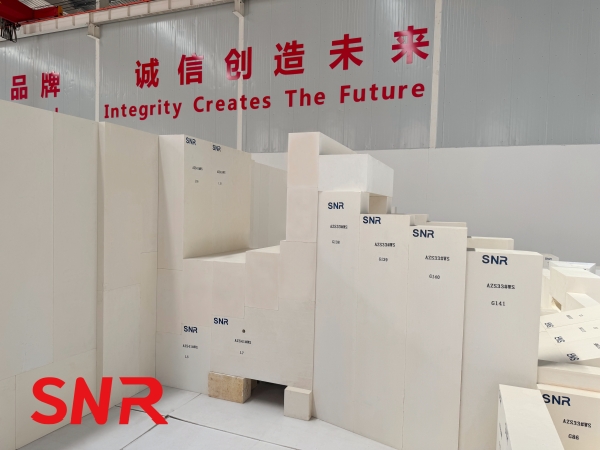
3.3 Furnace Bottom, Sidewall and Flue Auxiliary Areas
Furnace bottom linings are immersed in static molten glass for a long time, with no obvious high-speed scouring and relatively mild corrosion. Upper sidewalls above the glass line are mainly affected by flue gas corrosion and cyclic thermal shock, without direct molten glass erosion. Flue and regenerator zones bear low-intensity flue gas scouring and high-temperature oxidation, with the lowest overall corrosion risk in the furnace.
Selection logic: Furnace bottom areas require graded zoning design based on glass type, operating temperature, corrosion intensity, and molten glass flow conditions. AZS 33 is commonly adopted for flat bottom areas with low temperature, static molten glass, and mild corrosion, which effectively controls refractory costs. For furnace bottom corners, slope transition zones, and partial areas with weak scouring and stress concentration, AZS 36 is preferred to avoid uneven local corrosion. For large high-yield furnaces and high-temperature special glass furnaces with aggravated bottom corrosion, local AZS 41 layout is feasible to enhance lining stability. For sidewall upper structures, flues, and other low-corrosion auxiliary zones, AZS 33 is the preferred grade to balance service performance and overall procurement cost.
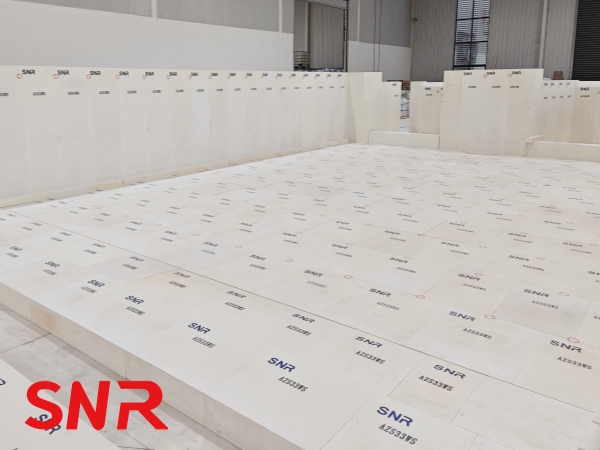
4. Practical Engineering Precautions for Fused Cast AZS Blocks Application
Scientific grade matching is only the first step of refractory system optimization. On-site masonry quality, furnace baking curve formulation, and daily operation stability directly determine the actual service effect of fused cast AZS blocks. Most on-site lining failure cases result from non-standard application and operation, rather than inherent material performance defects.
4.1 Construction and Masonry Precautions
Fused cast AZS blocks feature high hardness and large self-weight, so edge chipping and internal micro-cracks may occur due to collision and forced extrusion during masonry. On-site construction requires strict control of brick joint gaps, with special supporting AZS mortar exclusively used for joint filling, to avoid gap leakage and stress mismatch caused by inconsistent thermal expansion coefficients. For core zones including glass lines and furnace throats, integral full bricks are prioritized to reduce splicing gaps and eliminate hidden risks of molten glass penetration along joints.
4.2 Furnace Baking and Temperature Rise Control
All fused cast AZS grades have strict temperature rise requirements, with differentiated thermal shock tolerance among different grades. Excessively fast temperature rise in the low-temperature stage will cause rapid water loss and unbalanced thermal expansion inside bricks, inducing irreversible micro-cracks and structural loosening. The universal baking principle is slow heating and staged heat preservation: the temperature rise rate is controlled within 10–15℃/h below 800℃, and can be appropriately increased after complete dehydration and structural stabilization. Special attention should be paid to AZS 41 laying zones, which require gentler temperature rise rates and longer heat preservation stages to adapt to its compact structure and prevent thermal stress damage.
4.3 Daily Operation and Maintenance Optimization
Stable production parameters are the core guarantee for extending the service life of fused cast AZS linings. Frequent furnace temperature fluctuation, sudden adjustment of batch alkali content, and unstable molten glass flow will significantly accelerate glass line corrosion and throat scouring. In daily operation, engineers need to maintain stable temperature and flow fields, avoid long-term over-temperature operation beyond design parameters, and regularly detect the residual thickness of linings in key zones. Timely targeted thermal repair for slight local wear can effectively prevent damage expansion and extend the overall furnace campaign life.
5. Procurement & Selection Decision-Making Suggestions for Procurement Managers
For procurement managers responsible for glass furnace refractory sourcing, the core goal is to balance material performance, initial procurement cost, and full-cycle operating cost. It is necessary to avoid two extreme strategies: blind upgrading to high-grade AZS leading to redundant cost investment, and excessive pursuit of low prices resulting in frequent maintenance and shortened furnace service life.
.jpg)
The first principle is working condition-oriented graded matching. A targeted zoning material system should be established based on furnace type, glass formula, operating temperature, and production mode: deploy AZS 41 for core high-corrosion and high-scour zones of large continuous production furnaces, adopt AZS 36 for conventional key zones, and configure AZS 33 for low-corrosion auxiliary zones. For small intermittent production furnaces with mild working conditions, matching grades can be appropriately reduced on the premise of meeting safety and service life standards to control comprehensive costs.
The second key point is focusing on incoming material stability rather than nominal grade labels. Many unqualified products on the market fail to meet actual component standards despite standard nominal grades. Incoming inspection must cover chemical composition reports, zirconia content uniformity, bulk density, and porosity indicators to eliminate substandard fused cast AZS products with insufficient effective components and loose structures.
The third is establishing full-cycle cost awareness. Although AZS 41 has a higher unit price than medium and low-grade AZS materials, its excellent performance under extreme working conditions can effectively reduce unplanned shutdown losses, routine maintenance costs, and glass product yield defects caused by lining wear. From the perspective of the entire furnace campaign cycle, graded precise matching delivers higher comprehensive cost performance than full-furnace single-grade configuration.
6. How to Choose a Reliable Fused Cast AZS Blocks Supplier
Material grading selection determines the theoretical service effect of refractory linings, while the comprehensive strength of suppliers decides the actual stability and consistency of on-site application. For long-cycle operation of glass furnaces, the quality consistency of fused cast AZS blocks is far more important than short-term price advantages. Professional refractory manufacturers with mature glass furnace application experience can effectively reduce quality fluctuation risks and provide targeted technical support. The core evaluation dimensions for selecting a reliable AZS refractory supplier are as follows.
Chemical composition stability and zirconia content consistency: Qualified suppliers implement precise raw material proportioning and strict smelting temperature control, ensuring the zirconia content of each batch of products stably meets standard requirements without obvious component deviation. Stable chemical composition guarantees consistent anti-corrosion and high-temperature performance of furnace linings, avoiding local uneven wear caused by material quality differences.
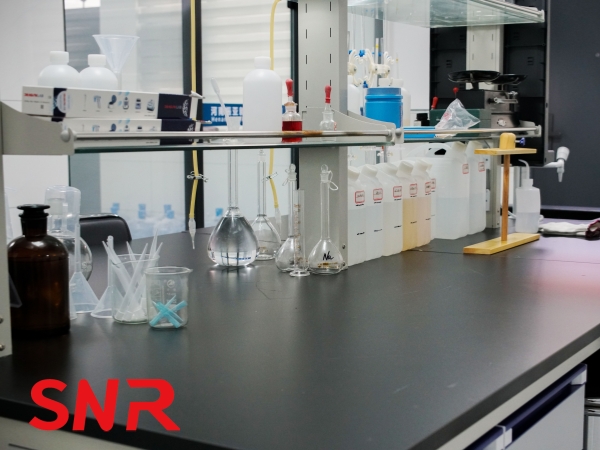
High-standard casting quality and bubble control: Fused cast AZS block quality is highly dependent on casting process control. Excellent manufacturers adopt precise electric melting and integral casting processes to strictly control the quantity and size of internal bubbles. A small number of uniformly distributed tiny bubbles can relieve thermal stress, while excessive or concentrated large bubbles will reduce brick compactness and anti-corrosion performance. Mature bubble control technology is essential for long-term lining stability.
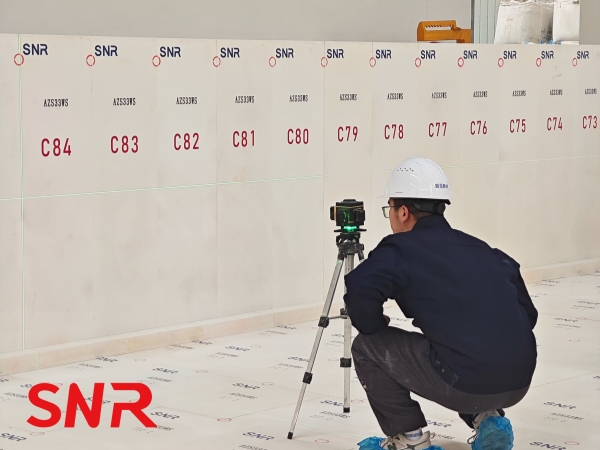
Strict dimensional accuracy control: Glass furnace masonry requires high fitting precision of refractory blocks. Reliable suppliers adopt precise mold casting and post-processing calibration to ensure accurate brick size and regular shape. Ultra-low dimensional deviation ensures tight brick joint fitting on site, reduces the consumption of filling mortar, and avoids molten glass penetration along gaps caused by dimensional errors.
Rich furnace application experience: Professional refractory suppliers possess long-term supporting experience in float glass, container glass, borosilicate glass, and other production lines. They can provide targeted grading matching schemes and on-site construction guidance according to differentiated furnace working conditions, instead of simply supplying standard products. Mature application experience helps customers optimize refractory zoning designs, avoid matching errors, and maximize furnace campaign life.
Complete after-sales technical service system: Outstanding suppliers provide full-cycle services including pre-sale scheme optimization, on-site masonry technical guidance, furnace baking parameter consultation, and in-operation failure analysis. Timely professional technical support can solve on-site application problems efficiently and reduce hidden lining damage risks caused by non-standard construction and operation.
7. Common Mistakes in Fused Cast AZS Block Selection for Glass Furnaces
Selecting suitable fused cast AZS blocks is not simply a matter of choosing the highest zirconia content grade. In practical glass furnace engineering, improper refractory selection and unreasonable zoning design are common causes of shortened lining service life, increased maintenance costs, and unexpected production risks. Understanding common selection mistakes helps glass manufacturers achieve better refractory performance and overall economic benefits.
7.1 Selecting AZS Grade Based Only on Zirconia Content
A common misunderstanding in refractory selection is that higher zirconia content always means better performance under all operating conditions. Although AZS 41 provides excellent corrosion and scouring resistance in severe working environments, it is not necessarily the most economical or suitable choice for every furnace area.
The optimal refractory solution should be determined by comprehensive factors including furnace type, glass composition, operating temperature, molten glass flow characteristics, corrosion intensity, and expected campaign life. Scientific zoning design using AZS 33, AZS 36, and AZS 41 in different areas can achieve better overall performance and cost efficiency than applying a single high-grade material throughout the entire furnace.
7.2 Applying the Same AZS Grade Throughout the Entire Furnace
Different furnace zones experience different corrosion mechanisms and operating stresses. Glass line areas mainly suffer from molten glass erosion, alkali vapor corrosion, and gas-liquid alternating thermal stress, while upper structures are primarily affected by furnace atmosphere corrosion and temperature fluctuations.
Using one AZS grade for the entire furnace may result in unnecessary refractory investment or insufficient protection in critical areas. A properly designed zoning system allows each furnace section to use the most suitable refractory grade according to its actual service conditions.
7.3 Focusing Only on Initial Purchase Price
The lowest initial refractory cost does not always represent the lowest total operating cost. Premature lining wear, glass quality defects, repair shutdowns, and shortened furnace campaign life may create significantly higher economic losses than the original refractory investment.
For this reason, refractory selection should be evaluated from a full-cycle cost perspective. Proper grade matching can reduce maintenance risks and improve overall furnace operation efficiency, even if the initial material investment is slightly higher.
7.4 Ignoring Manufacturer Quality Consistency
Even with the same nominal AZS grade, actual product performance may vary significantly among different manufacturers due to differences in raw material quality, zirconia distribution, melting process control, casting technology, bubble control, and dimensional accuracy.
Reliable fused cast AZS blocks require not only correct chemical composition but also stable manufacturing processes and strict quality control. Consistent product quality is essential for achieving predictable refractory performance during long-term glass furnace operation.
8. Conclusion
As an indispensable core refractory material for glass furnaces, graded selection and scientific zoning application of fused cast AZS blocks are critical to furnace operating stability and full-cycle benefit control. The three mainstream AZS grades form a mutually complementary performance system: AZS 33 serves as an economical and reliable option for low-corrosion auxiliary zones, AZS 36 achieves optimal performance-cost balance for conventional key zones and remains the industry mainstream, and AZS 41 is applicable to extreme working condition zones with high temperature, high corrosion, and strong scouring.
The core engineering principle throughout the selection process is that the most suitable refractory materials match actual working conditions. Blind pursuit of high-grade materials causes cost waste, while mismatched low-grade materials bring potential operational risks. In actual production, engineers should combine glass type, temperature parameters, and molten glass flow characteristics to solve core problems such as glass line corrosion and throat lining wear through standardized construction and scientific daily operation. Procurement managers are advised to cooperate with professional and experienced refractory suppliers to implement precise graded matching, improve furnace operational stability, and support long-term efficient production.
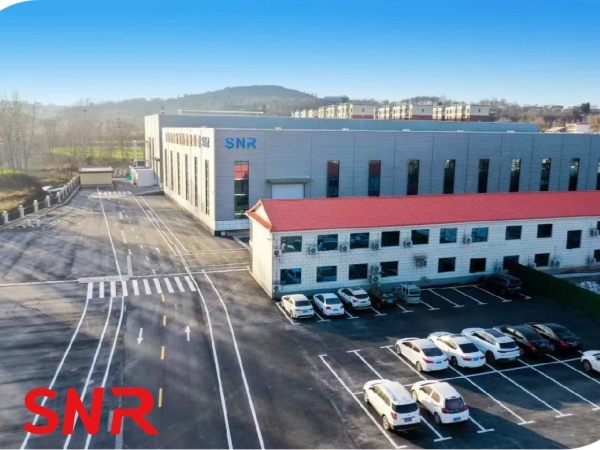
For glass manufacturers seeking reliable fused cast AZS block solutions, SNR delivers high-quality AZS 33, AZS 36, and AZS 41 fused cast products tailored to different glass furnace zones and service conditions. With 20 years of professional fused cast AZS production and glass furnace application experience, the team focuses on customized refractory solutions for diverse glass production scenarios. Adhering to strict full-process quality control, SNR provides practical, cost-effective refractory support to improve furnace operating stability, reduce operational risks, and sustain efficient glass production.
Contact SNR for professional fused cast AZS block solutions:
 Email: [email protected]
