
When purchasing fused cast AZS blocks for a glass furnace, price, grade and delivery time are usually the first things buyers compare. These factors are important, but they are not enough to determine whether a refractory block is suitable for a particular furnace.
Two fused cast AZS blocks with the same grade designation may differ in chemical composition, casting quality, internal structure, physical properties and machining accuracy. At the same time, a block that performs well in one furnace area may not be the right choice for another.
Before placing an order, it is worth asking your AZS supplier a few more specific questions. The answers can help you compare suppliers on more than just price and choose a refractory that matches the actual working conditions of your glass furnace.
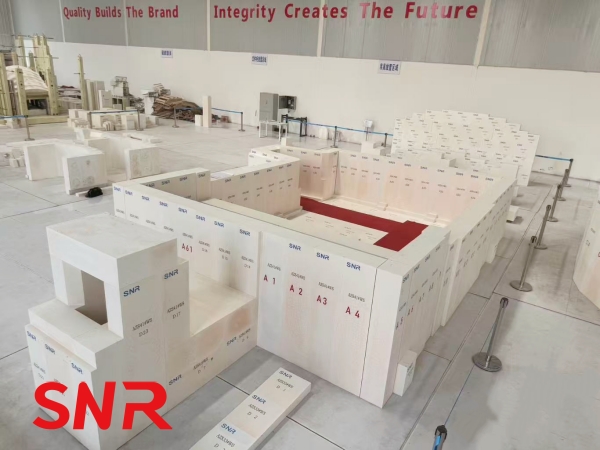
1. Which AZS Grade Do You Recommend—and Why?
AZS 33, AZS 36 and AZS 41 are widely used fused cast AZS grades in glass furnace construction. The grade designation generally relates to the nominal ZrO₂ content, but the exact chemical composition and guaranteed ranges can vary between manufacturers.
For this reason, AZS grades should not be viewed simply as low, medium and high grades. A higher-ZrO₂ grade is not automatically the best choice for every location in a glass furnace.
Grade selection should take into account the actual application, including:
♦ Furnace area
♦ Glass type and composition
♦ Operating temperature
♦ Glass flow conditions
♦ Corrosion severity
♦ Glass quality and contamination requirements
♦ Expected service conditions
For example, different areas of a furnace may experience very different levels of corrosion and thermal load. A grade that is suitable for one area may not provide the best balance of performance and cost in another.
When discussing an AZS quotation, do not ask only, “What grades do you have?” A more useful question is:
“Why do you recommend this AZS grade for this particular furnace area?”
A professional supplier should be able to explain the recommendation based on the actual application rather than simply offering the highest grade available.
2. What Is the Actual ZrO₂ Content?
The AZS grade name is only the starting point. Buyers should also check the actual chemical composition specified for the product.
Ask the supplier for the guaranteed ZrO₂ range and, where applicable, the actual chemical analysis of the production batch.
The main components normally considered in an AZS chemical analysis include:
♦ ZrO₂
♦ Al₂O₃
♦ SiO₂
♦ Na₂O
♦ K₂O
♦ Fe₂O₃
♦ TiO₂
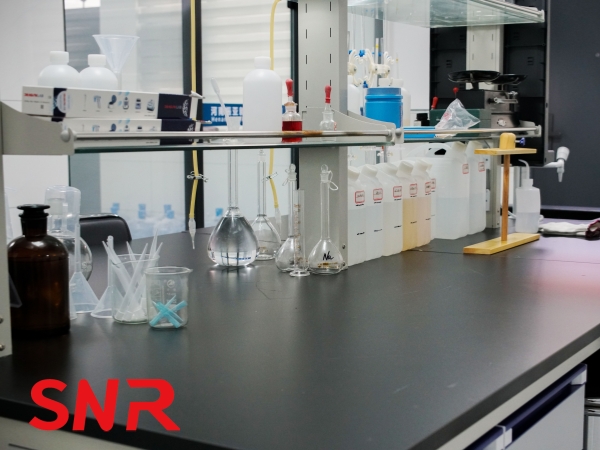
The control of these components is important when evaluating the material's high-temperature behavior, corrosion characteristics and potential impact on glass quality.
It is also important not to assume that AZS 33, AZS 36 or AZS 41 has exactly the same chemical composition from every manufacturer. Product specifications and guaranteed ranges can differ.
Therefore, instead of relying only on the grade designation, compare the supplier's actual technical specification.
Ask the supplier:
“Can you provide the guaranteed chemical composition and the actual batch analysis?”

3. What Are the Guaranteed Density and Porosity Values?
Bulk density and apparent porosity are two basic physical properties that should be checked when comparing fused cast AZS blocks.
Bulk density describes the mass of the refractory per unit volume and provides useful information about the compactness of the material.
Apparent porosity indicates the proportion of open pores within the refractory that can be penetrated by fluids under the test conditions.
For glass-contact applications, lower apparent porosity can help limit the penetration of molten glass and corrosive materials into the refractory. However, apparent porosity should not be considered a standalone measure of service performance.
The actual performance of fused cast AZS blocks also depends on factors such as:
♦ Internal microstructure
♦ Chemical composition
♦ Glass phase characteristics
♦ Casting quality
♦ Furnace temperature
♦ Glass composition
♦ Operating conditions
When comparing suppliers, ask for the guaranteed density and porosity values, together with the test methods used to determine them.
For large orders, it is also useful to check whether the supplier can provide actual inspection results for the production batch.
Ask the supplier:
“What are the guaranteed bulk density and apparent porosity values, and how are they tested?”
4. How Was the AZS Block Cast?
Fused cast AZS blocks are produced by melting the raw materials and casting the molten material into molds. The casting process plays an important role in the internal structure of the finished block.
Different manufacturers may use different casting technologies. Terms such as PT, QX, ZWS and WS can be found in the fused cast AZS industry, but these designations are not a globally unified classification system. Their exact definitions and process details may vary between manufacturers.
For buyers, the important point is to understand how the ordered blocks are cast and how the casting process affects the internal structure and usable working area.
The casting process can influence factors such as:
♦ Internal structural uniformity
♦ Shrinkage distribution
♦ Density distribution
♦ Working area
♦ Block design and installation orientation
This information becomes particularly important when purchasing fused cast AZS blocks for critical furnace areas.
.png)
Ask the supplier:
“Which casting method will be used for these blocks, and what does it mean for their internal structure and usable working area?”
5. Where Is the Shrinkage Area Located?
During the cooling and solidification of fused cast AZS block, shrinkage occurs as the molten material changes from a liquid to a solid state. Depending on the casting design, a shrinkage area may remain within the block.
The important issue for the buyer is not simply whether shrinkage exists, but where it is located and how the block is designed to be used.
The position and size of the shrinkage area should be considered when determining the effective working area and installation orientation of the block.
For blocks used in important furnace areas, such as sidewalls, tank bottoms or throats, the supplier should be able to provide clear information about the casting structure and recommended working face.
This information can also help the installation team understand how the blocks should be oriented during furnace construction.
Ask the supplier:
“Where is the shrinkage area located, and which face is intended to be used as the working face?”
6. What Corrosion Test Data Can You Provide?
Corrosion resistance is one of the key reasons fused cast AZS block is widely used in glass furnaces. However, statements such as “excellent corrosion resistance” are not enough for a meaningful technical comparison.
Buyers should ask how the supplier evaluates the corrosion resistance of its AZS products.
Useful information includes:
♦ Test temperature
♦ Test duration
♦ Test glass composition
♦ Test method
♦ Measured corrosion result
The test conditions are important because corrosion behavior depends strongly on the environment in which the material is tested.
Laboratory corrosion tests are useful for comparing refractory materials under defined conditions. However, laboratory results should not be treated as a direct prediction of actual furnace campaign life.
Actual furnace corrosion is affected by many factors, including glass composition, temperature, glass movement, furnace design and long-term operating conditions.
Therefore, a test result is most useful when the buyer understands exactly how the test was conducted.
Ask the supplier:
“Can you provide the corrosion test method, test conditions and actual test results?”
7. How Do You Control the Risk of Glass Contamination?
For glass manufacturers, refractory service life is only part of the equation. The refractory must also meet the glass quality requirements of the furnace.
During long-term operation, refractory materials are exposed to molten glass at high temperature. Corrosion, glass-phase behavior and local structural changes may contribute to stones, inclusions, bubbles or other glass defects.
For this reason, buyers should ask what tests and quality controls the supplier uses to evaluate the potential impact of the AZS material on glass quality.
Depending on the product and application, relevant information may include:
♦ Glass-phase exudation testing
♦ Bubble separation testing
♦ Corrosion testing
♦ Chemical composition control
♦ Production and inspection records
These tests can provide useful information about material behavior under defined conditions. However, no single laboratory test can reproduce every condition inside an operating glass furnace.
A good AZS supplier should therefore be able to discuss both refractory durability and glass quality requirements.
Ask the supplier:
“What tests or quality controls do you use to evaluate the potential impact of the fused cast AZS blocks on glass quality?”
8. Can You Provide Batch Inspection Data?
A Technical Data Sheet describes the agreed product specification. It does not necessarily show the actual results of every production batch.
For this reason, buyers purchasing a significant quantity of fused cast AZS blocks should ask whether batch inspection records are available.
Depending on the agreed quality requirements, a batch inspection report may include:
♦ Batch number
♦ Production date
♦ Chemical composition
♦ Bulk density
♦ Apparent porosity
♦ Cold crushing strength
♦ Other agreed technical indicators
Batch inspection data allows buyers to compare the delivered material with the agreed specification instead of relying only on catalogue or website information.
This is particularly important for large furnace projects, where a large quantity of blocks may be produced over a period of time.
The inspection items, test methods and acceptance requirements should ideally be agreed before production begins.
Ask the supplier:
“Can you provide the inspection report for the actual production batch?”
9. What Dimensional Tolerances Can You Guarantee?
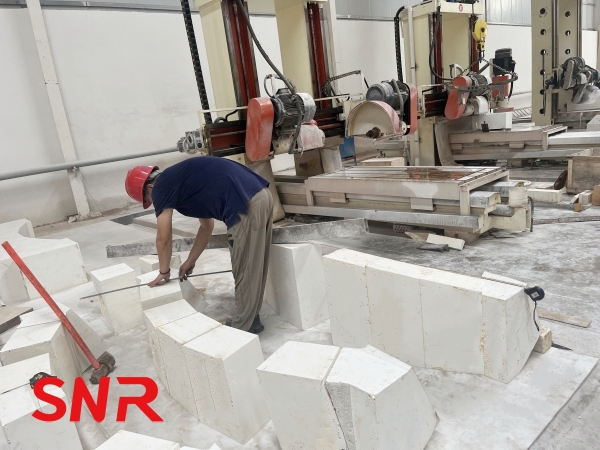
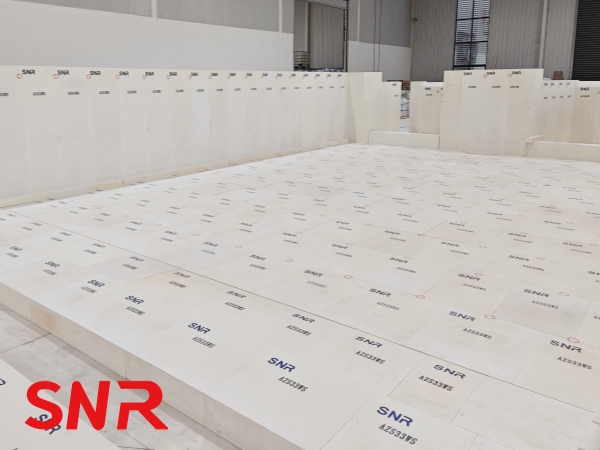
Fused cast AZS blocks are not only refractory materials; they are also masonry components. Their dimensions and machining quality directly affect furnace construction.
Before production, buyers should confirm:
♦ Nominal dimensions
♦ Dimensional tolerances
♦ Machining requirements
♦ Flatness requirements where applicable
♦ Chamfering
♦ Drilling
♦ Special shapes
♦ Drawing requirements
For customized fused cast AZS blocks, the final drawings should be reviewed and confirmed before mass production.
This is particularly important for special-shaped blocks or blocks that require machined surfaces, holes or other customized features.
Good dimensional control helps the construction team install the blocks according to the furnace design and reduces the risk of rework caused by machining errors.
Ask the supplier:
“What dimensional tolerances and machining accuracy can you guarantee?”
10. Is This AZS Block Suitable for My Specific Furnace Area?
All the previous questions ultimately lead to one important point: Is the fused cast AZS block actually suitable for the furnace area where it will be installed?
Instead of asking only for a price for AZS 33, AZS 36 or AZS 41, buyers should provide the supplier with enough information to understand the application.
Useful information may include:
♦ Glass type
♦ Furnace type
♦ Furnace capacity
♦ Specific installation area
♦ Operating temperature
♦ Glass operating conditions
♦ Expected service requirements
♦ Block dimensions
♦ Engineering drawings
With this information, the supplier can make a more meaningful recommendation regarding the AZS grade, casting process, block design and application.
The goal is not to select the highest-grade AZS available. The goal is to select a block whose material properties and design are appropriate for the conditions in which it will actually be used.
Ask the supplier:
“Based on our furnace conditions and drawings, why is this fused cast AZS block suitable for this application?”
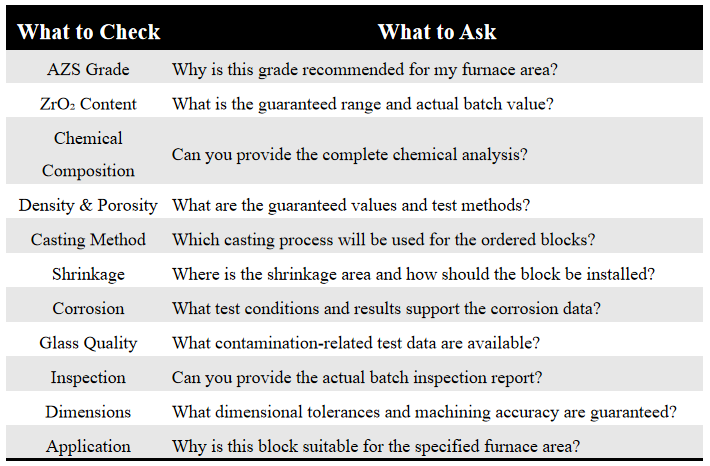
AZS Purchasing Checklist
Before placing an order, buyers can use the following checklist to make sure the main technical points have been covered.
Final Thoughts
Buying fused cast AZS blocks should involve more than comparing price per ton. The AZS grade, chemical composition, casting process, internal structure, physical properties, corrosion behavior and dimensional accuracy all need to be considered together with the actual furnace application.
A reliable AZS supplier should be able to provide more than a quotation. The supplier should be able to explain the specification, provide appropriate technical and inspection data, and recommend a suitable product based on the actual furnace conditions.
Why Choose SNR Fused Cast AZS Blocks?
When selecting a supplier for fused cast AZS blocks, technical support and product consistency are just as important as the material itself. SNR specializes in fused cast AZS refractory blocks for glass furnaces, offering AZS 33, AZS 36 and AZS 41 grades for different furnace applications.
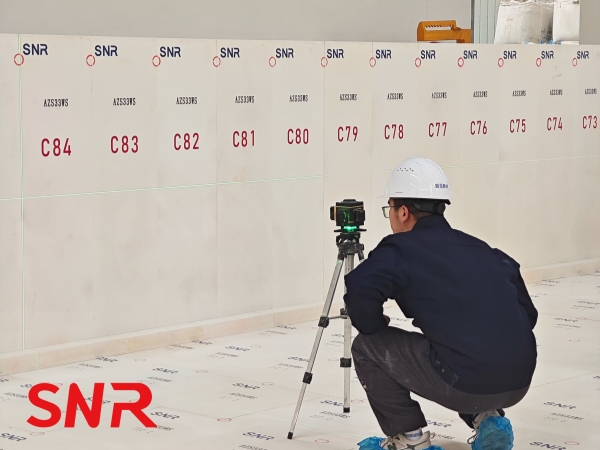
SNR can provide AZS blocks with customized shapes and dimensions based on furnace drawings and project requirements. From grade selection and block design to production and quality inspection, the focus is on matching the refractory to the actual working conditions of each furnace area.
If you are planning a new glass furnace, furnace rebuild or refractory replacement project, contact SNR to discuss your fused cast AZS block requirements and receive a product recommendation based on your furnace conditions and drawings.
 Email: [email protected]
