
In glass furnace maintenance, attention naturally focuses on the areas exposed to the most visible damage: tank sidewalls, the throat, and the crown. Yet another part of the furnace deserves closer inspection: the riser and port neck.
These components are easy to overlook because they are located above the glass line and do not normally come into direct contact with molten glass. However, in cross-fired regenerative glass furnaces, they operate under demanding thermal and chemical conditions. Alkali-bearing vapors, temperature fluctuations, high-temperature airflow, and deterioration of refractory joints can all affect their performance.
When the port structure deteriorates, the consequences may extend beyond the refractory lining itself. Airflow distribution, combustion stability, heat loss, and furnace operating efficiency can also be affected.
The riser and port neck may occupy a relatively small area of the furnace, but their condition deserves attention during refractory selection, installation, and campaign inspections.
1. Which Glass Furnaces Have Risers and Port Necks?
This article focuses primarily on cross-fired regenerative glass furnaces, commonly used in container glass, float glass, and various specialty glass applications.
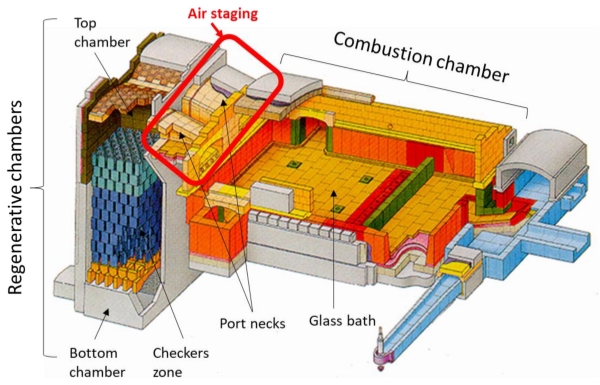
In this furnace design, regenerators recover heat from outgoing exhaust gases and transfer it to incoming combustion air. The preheated air then passes through the port structure before entering the melting chamber.
The exact arrangement varies with furnace design, but the typical airflow path can be described as follows:
Regenerator: Checkerwork absorbs heat from exhaust gases during one firing cycle.
Riser: The near-vertical passage carries preheated combustion air from the regenerator toward furnace level.
Port neck: The connecting passage directs the airflow toward the port opening.
Port opening: The combustion air enters the furnace and interacts with the fuel to establish the intended flame pattern.
During operation, the regenerators alternate between heating and heat recovery. Reversal commonly occurs at intervals of several minutes, with the actual timing determined by furnace design and operating conditions.
This operating cycle exposes the refractory lining to repeated thermal changes. Meanwhile, the airflow passing through the port structure can reach temperatures of approximately 1,000–1,300°C in some furnace designs, although actual temperatures vary considerably.
Understanding this operating environment is the first step toward selecting suitable refractory materials for the riser and port neck.
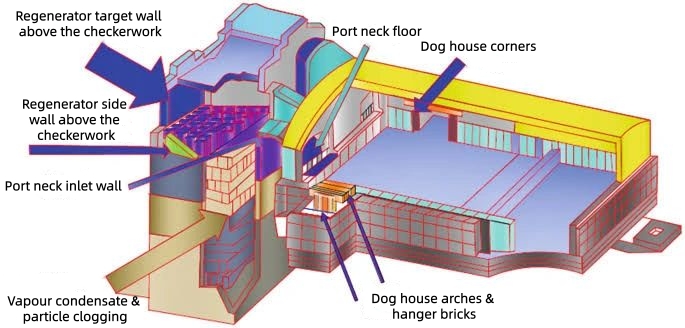
2. Why Is the Riser and Port Neck Area Vulnerable to Deterioration?
Being above the glass line does not mean a refractory lining is protected from chemical attack or thermal damage.
The riser and port neck face a different combination of stresses from the refractory blocks in direct contact with molten glass. Four factors deserve particular attention.
2.1 Alkali Vapor and Chemical Attack
During glass melting, batch materials release volatile compounds. Depending on the glass composition and operating conditions, these may include sodium- and potassium-bearing species, sulfates, boron-containing compounds, and other volatile constituents.
These substances can travel with the hot gases and interact with refractory surfaces as the local temperature and gas composition change.
Alkali-bearing species may react with alumina-silica refractories, forming alkali-containing reaction products and altering the original microstructure. Depending on the refractory composition and exposure conditions, the resulting reactions can contribute to local expansion, cracking, surface deterioration, and spalling.
The severity of attack depends on several variables, including the alkali concentration, temperature profile, exposure duration, and properties of the refractory itself.
The practical implication is clear: refractory materials in the port structure must be selected with the actual chemical environment in mind, rather than on the assumption that areas above the glass line experience little corrosion.
2.2 Thermal Cycling During Furnace Reversal
Cross-fired regenerative furnaces periodically reverse their firing direction. As the combustion and exhaust paths switch, the thermal conditions within the port structure change accordingly.
Repeated temperature variations can generate thermal stresses within the refractory lining. Differences in thermal expansion between individual bricks, mortar joints, and adjacent construction materials may further increase stress concentrations.
Over time, these conditions can contribute to cracking, joint deterioration, and surface spalling.
The extent of damage depends on the refractory's thermal properties, the magnitude and frequency of temperature changes, the structural arrangement, and the quality of installation.
For this reason, thermal-cycle resistance should be considered alongside chemical resistance when evaluating refractory materials for the riser and port neck.
2.3 High Temperature and Dimensional Stability
The riser and port neck must maintain their intended geometry while exposed to high temperatures and repeated thermal changes.
Refractory materials subjected to prolonged high-temperature loading may deform or creep, depending on their composition, microstructure, applied stress, and operating temperature.
Even relatively small changes in the shape of a passage can affect clearances, airflow distribution, or the condition of surrounding joints.
Dimensional stability is therefore an important consideration when selecting refractory blocks for geometrically sensitive sections of the port structure.
Material selection should be based on relevant high-temperature properties and the requirements of the furnace design, rather than on room-temperature strength alone.

2.4 Cracking and Air Leakage
Cracks, deteriorated joints, and gaps in the port structure can create unintended paths for gas movement.
Depending on furnace pressure and the location of the defect, these openings may permit air leakage or unwanted gas flow. This can disturb the intended airflow distribution and thermal balance.
If the preheated combustion air reaches the port at a lower temperature than expected, or if the flow distribution becomes uneven, combustion performance may be affected. Operators may then need to investigate burner settings, air distribution, regenerator performance, and other operating variables.
Not every combustion imbalance originates in the refractory lining. Nevertheless, the condition of the riser and port neck should not be overlooked when unexplained changes in furnace operation occur.

3. What Can Port Structure Deterioration Mean for Furnace Operation?
Refractory deterioration in the port structure can create costs that are less visible than damage to the tank sidewalls.
The first concern is thermal efficiency. Heat loss through a deteriorated lining, together with unwanted gas movement, may affect the thermal conditions of the port structure and the temperature of the combustion air.
The second concern is combustion stability. Changes in airflow distribution between the two sides of a cross-fired furnace can complicate efforts to maintain consistent operating conditions. The effects depend on the furnace configuration, combustion system, and severity of the defect.
The third concern is maintenance planning. If cracking, deformation, or spalling progresses unnoticed, the required repair may become more extensive than an earlier intervention would have been.
In severe cases, port structure damage may contribute to restrictions on furnace operation or require unplanned maintenance. Whether a repair requires a partial shutdown or a larger intervention depends on the location and extent of the damage, the furnace design, and the available repair procedures.

These risks explain why port structure inspection should form part of a broader furnace maintenance strategy.
However, refractory condition is only one part of the picture. Fuel consumption, NOx emissions, flame behavior, and melting performance are also influenced by combustion settings, furnace pressure, glass composition, regenerator condition, and operating practices. Any performance problem should be evaluated in this wider context.
4. Why Consider Dense Fused Cast AZS Blocks for the Riser and Port Neck?
Fused cast AZS block is an important refractory material in glass furnace construction. It is produced by electrically melting a mixture based primarily on alumina, zirconia, and silica, followed by casting and controlled solidification.
Its microstructure typically consists of zirconia-rich and alumina-rich crystalline phases within a glassy matrix. The resulting properties depend on the chemical composition, manufacturing process, cooling conditions, and specific product grade.
For selected riser and port neck applications, fused cast AZS blocks can offer advantages where a dense structure, chemical resistance, and dimensional stability are important.
Its suitability should nevertheless be evaluated against the actual operating temperature, alkali exposure, thermal cycling, structural design, and installation requirements.
4.1 Microstructure and Resistance to Chemical Penetration
One consideration when evaluating refractory materials is their open porosity and pore connectivity.
Open, interconnected pores can provide pathways for liquids or reactive species to penetrate a refractory body. Depending on the chemical environment, this penetration may allow reactions to extend beneath the exposed surface.
Dense fused cast AZS products can have low open porosity, which may help limit penetration under suitable operating conditions. However, actual porosity and corrosion performance vary by product and should be confirmed using the manufacturer's technical data.
It is important to distinguish between resistance to chemical penetration and resistance to all forms of corrosion. Low open porosity alone does not guarantee immunity to alkali attack, thermal cracking, or other forms of deterioration.
For the riser and port neck, the appropriate comparison should consider the complete combination of material properties and operating conditions.
4.2 Fused Cast AZS Blocks Compared with Other Refractory Options
Fused cast AZS block is not the only refractory material used in glass furnace port structures. Sintered AZS, silica refractories, and other alumina-silica materials may be considered in different sections, depending on the furnace design and the intended service conditions.
The following table summarizes general selection considerations.
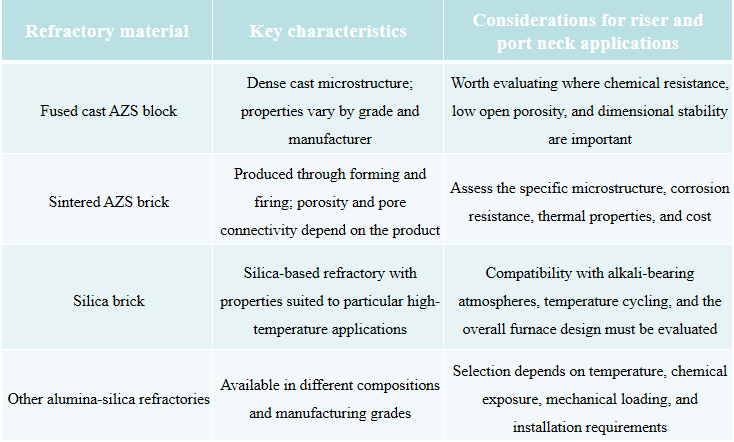
No material should be selected solely on the basis of its name or a single property. Actual product data and the requirements of the specific furnace location should determine the final choice.
4.3 Dimensional Stability and Installation
The geometry of the port structure is important for maintaining the intended airflow path and ensuring that adjacent components fit correctly.
Fused cast AZS products can offer useful dimensional characteristics, but dimensional accuracy and performance depend on the particular product, casting design, machining requirements, and installation method.
Correct block dimensions, suitable joint design, and proper installation are essential. A high-quality refractory block cannot compensate for poor fitting, inadequate support, or incorrectly constructed joints.
4.4 Consider the Glassy Phase and the Intended Application
Fused cast AZS contains a glassy phase that influences its properties at high temperatures. Under certain conditions, this phase may exude from the refractory.
This characteristic is particularly relevant when evaluating applications involving direct contact with molten glass, where exudation may affect glass quality or produce defects.
The implications for the riser and port neck are different because these components are generally outside the direct glass-contact zone. However, the actual temperature, local geometry, and possibility of material entering the melt should still be considered during design.
The correct conclusion is not that exudation can never occur in a port structure, but that the material must be evaluated according to its specific location and operating conditions.
5. How to Select the Appropriate AZS Grade
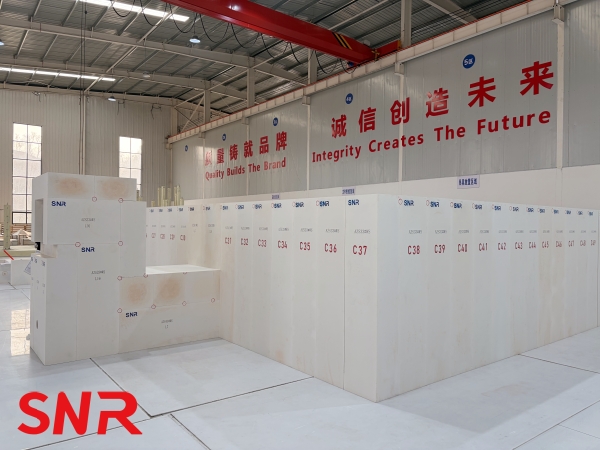
Fused cast AZS block is commonly available in grades identified as AZS 33, AZS 36, and AZS 41. These designations broadly correspond to zirconia contents of approximately 33%, 36%, and 41%, respectively, although the precise composition should be verified against the manufacturer's specification.
A higher zirconia content does not automatically make a grade the most economical or suitable choice for every furnace location.
In areas directly exposed to molten glass, corrosion resistance is a major consideration. In the riser and port neck, the selection may be influenced by a different combination of factors, including alkali-bearing atmospheres, temperature fluctuations, mechanical requirements, and the geometry of the lining.
For some conventional soda-lime glass furnace designs, AZS 33 or AZS 36 may be suitable candidates. AZS 41 may also be considered when the operating conditions and required performance justify it.
These are general selection considerations, not universal rules. The final grade should be determined using the furnace drawings, operating conditions, product-specific technical data, and the requirements of the refractory lining design.
Before specifying a grade, consider the following questions:
►What is the expected operating temperature and temperature variation?
►What type and concentration of volatile compounds are present?
►What are the required dimensions and mechanical conditions of the lining?
►Which refractory materials are used in the adjacent sections?
►What installation method and joint materials are specified?
►What service performance is required for the planned campaign?
Answering these questions provides a more reliable basis for material selection than choosing a grade simply because it has a higher zirconia content.
6. How to Identify Potential Port Structure Problems
Routine inspection can help identify deterioration before it develops into a more extensive maintenance issue.
During normal operation, several changes may justify closer investigation:
►Difficulty maintaining expected combustion-air temperatures.
►Changes in airflow distribution between the two furnace sides.
►Unusual deterioration or visible damage around the port area.
►Changes in flame behavior or combustion balance.
►Signs of cracking, spalling, or joint deterioration during accessible inspections.
►Unexpected changes in heat loss or the thermal condition of the port structure.
These observations are warning signs, not proof that the refractory lining has failed.
For example, an unexpected reduction in preheated-air temperature may also result from regenerator performance, operating conditions, instrumentation, or other equipment-related factors. Similarly, changes in flame behavior may arise from burner settings, fuel conditions, or combustion-control problems.
A reliable diagnosis should therefore combine operating data, inspection findings, and an understanding of the furnace's normal performance.
During a Planned Cold Repair
A planned cold repair provides an opportunity to inspect the riser and port neck more thoroughly.
The inspection should consider:
Surface condition: Identify cracking, spalling, erosion, and other visible deterioration.
Joint condition: Check for open joints, damaged mortar, and evidence of movement.
Dimensional condition: Compare the lining with the original drawings and identify any deformation or displacement.
Adjacent materials: Examine interfaces between the port structure, regenerator, and surrounding refractory sections.
Campaign records: Compare the current findings with previous inspections and operating data.
Photographs and measurements can help establish a record of how the lining changes over time. This information supports decisions about repair scope, material selection, and the next campaign.
The objective is not to replace refractory materials unnecessarily. It is to identify deterioration accurately and make maintenance decisions based on the actual condition of the furnace.
7. The Bottom Line: Give the Riser and Port Neck the Attention They Deserve
The riser and port neck may not attract the same attention as the tank sidewalls or throat, but they form an important part of the combustion-air path in a cross-fired regenerative glass furnace.
Their refractory lining is exposed to high temperatures, repeated thermal changes, and potentially aggressive chemical environments. Cracking, joint deterioration, and changes in material performance may affect more than the lining itself, making these areas worth including in routine maintenance planning and cold-repair inspections.
Selecting the right refractory requires more than choosing a material with a high zirconia content. Furnace design, operating conditions, chemical exposure, dimensional requirements, and installation quality all contribute to the final decision.
Dense fused cast AZS is an option worth evaluating for suitable riser and port neck applications. The appropriate grade and lining arrangement should be confirmed against the requirements of the individual furnace.
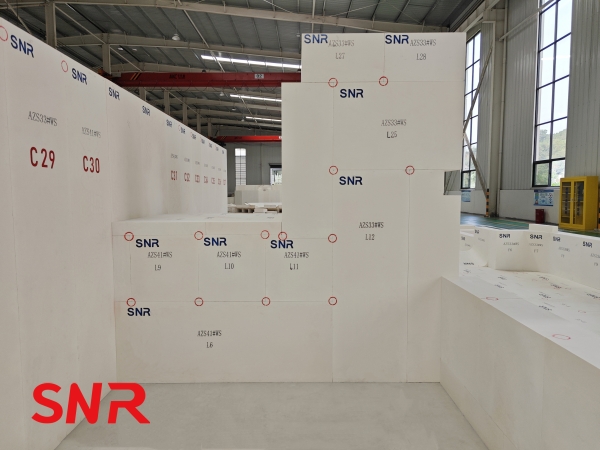
Discuss Your Glass Furnace Refractory Requirements with SNR
At SNR, we supply fused cast AZS blocks in AZS 33, AZS 36, and AZS 41 grades for glass furnace applications.
We understand that different furnace locations face different operating conditions. Our team can work with customers to review refractory requirements, evaluate suitable material options, and discuss lining arrangements based on furnace drawings and project specifications.
Whether you are preparing a new furnace project or planning a cold repair, choosing the right refractory starts with understanding the actual working conditions.
Contact SNR to discuss your glass furnace drawings and AZS requirements.
 Website: www.snrefractory.com
Email: [email protected]
