
As the core equipment in glass production, the glass melting furnace is required to operate continuously under temperatures exceeding 1500°C. The furnace throat, serving as the critical connection between the melting tank and the working end, plays a vital role in ensuring stable glass flow and precise flow control. Its operational stability directly affects furnace campaign life, glass product quality, and production efficiency.
Under long-term exposure to molten glass erosion, chemical corrosion, and thermal stress shock at extremely high temperatures, the throat area is highly susceptible to refractory corrosion, spalling, cracking, and even glass leakage. As a result, it has become one of the weakest links restricting the long-term stable operation of glass furnaces.
To address these operational challenges, the industry is increasingly focusing on three key areas: structural design optimization, advanced refractory material development, and maintenance technology improvement. Through the collaborative optimization of structural innovation, enhanced corrosion-resistant materials, and long-term maintenance systems, it is possible to overcome common issues such as throat damage, short service life, and high maintenance costs. This approach can provide glass manufacturers with more reliable and cost-effective solutions, helping achieve lower production costs, higher efficiency, improved product quality, and more stable furnace operation.
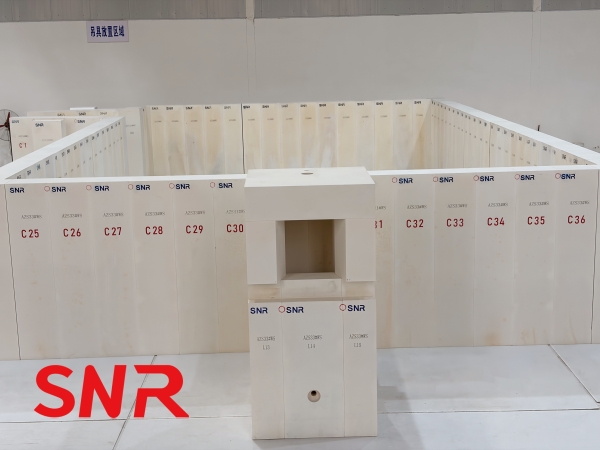
1. Structural Innovation: Optimizing Stress Distribution and Glass Flow to Reduce Corrosion Risks at the Source
The structural design of the furnace throat directly affects molten glass flow patterns, thermal stress distribution, and the mechanical load on refractory materials. Traditional throat designs usually adopt straight-channel or simple bent structures, which often lead to uneven glass flow velocity, concentrated local erosion, and thermal stress accumulation, thereby accelerating the corrosion and damage of fused cast AZS blocks. Through structural innovation and optimization, the operating conditions inside the throat can be fundamentally improved, providing a solid foundation for the long-term service performance of fused cast AZS blocks.
In terms of structural configuration innovation, the conventional straight-channel design can be replaced with an integrated “gradual contraction + curved transition” structure. By optimizing the inlet and outlet cross-sectional dimensions of the throat, the molten glass flow can transition more smoothly from the melting tank into the throat, reducing excessive local flow velocity and minimizing erosion caused by concentrated glass flow. Meanwhile, designing the inner wall with smooth curved surfaces helps reduce flow resistance, eliminate dead-flow zones, and lower the risk of localized corrosion.
For the special requirements of electronic glass furnaces, dedicated cooling structures can also be incorporated. A metallic cooling box can be installed between the outer throat block and the sidewall, combined with a cooling air supply system to achieve uniform heat dissipation. This design addresses the limitations of conventional cooling methods that fail to effectively cover heavily corroded internal areas, thereby reducing refractory damage caused by rapid thermal fluctuations and extending service life.
Regarding structural stress optimization, a “modular interlocking structure” can be adopted. Unlike traditional straight joints, the interlocking design uses stepped overlapping joints, creating a zigzag sealing path that effectively prevents direct molten glass penetration through the joints. The fused cast throat blocks are seamlessly integrated with the sidewall and bottom refractories of the furnace, reducing stress concentration at brick joints and minimizing the risk of cracking or displacement caused by thermal expansion and contraction.
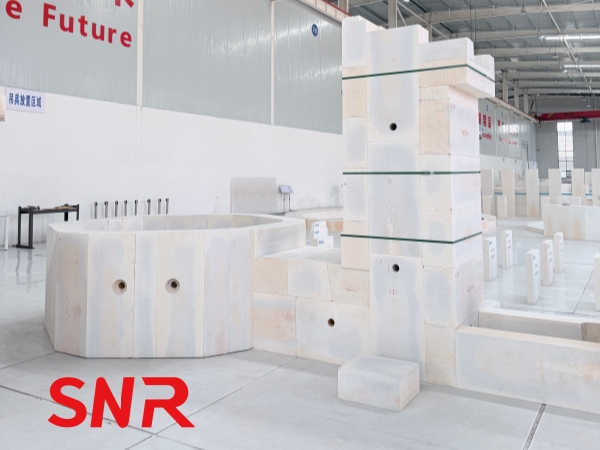
In addition, differentiated structural designs can be applied according to the varying corrosion intensity in different throat areas. For example, the brick thickness at the inlet and outlet areas—where glass erosion is most severe—can be increased, while the load-bearing angles of the refractory blocks can be optimized to ensure more uniform stress distribution. This improves the overall resistance of the structure to impact and deformation. Furthermore, by accurately calculating the thermal expansion coefficient of the throat structure and reserving appropriate expansion gaps, thermal stress under high-temperature operating conditions can be effectively relieved, reducing the likelihood of refractory cracking caused by restricted thermal expansion.

2. Upgraded Corrosion-Resistant Materials: Customized Fused Cast AZS Blocks for Long-Term Protection
The service life of a furnace throat largely depends on the corrosion resistance, thermal shock resistance, and high-temperature performance of its fused cast AZS blocks. Guided by the complex operating conditions of the throat area, the industry is increasingly focusing on material formulation optimization and manufacturing process upgrades to develop customized high-corrosion-resistant fused cast AZS blocks. The goal is to achieve “material-performance matching” based on specific operating conditions, thereby improving the long-term durability of the throat structure.
In terms of material formulation optimization, fused cast AZS blocks are widely used as the core base material. According to the corrosion intensity in different throat areas, the proportions of key components such as ZrO₂ and Al₂O₃ can be precisely adjusted to develop differentiated product grades. For heavily eroded areas such as the throat inlet and outlet, high-zirconia AZS-41# fused cast blocks are typically adopted, combined with reinforcing aggregates such as silicon carbide and zirconia to improve resistance against molten glass corrosion and high-velocity glass erosion. Tests have shown that under 1500°C operating conditions, the corrosion rate against soda-lime glass can be controlled within ≤0.8 mm/24 h, reaching an advanced industry level.
For moderately corroded areas in the middle section of the throat, AZS-36# fused cast AZS blocks can be used to balance corrosion resistance, cost efficiency, and installation convenience. At the same time, the glass phase composition inside the refractory is optimized by reducing low-melting-point substances and increasing the glass phase exudation temperature to ≥1400°C. This helps prevent structural loosening and accelerated corrosion caused by glass phase exudation at high temperatures.
Regarding microstructure control, special attention is given to optimizing the internal structure of the refractory blocks. The glass phase content is strictly controlled within 15%–18%, significantly lower than the 20%–25% typically found in conventional AZS fused cast blocks. Through formulation optimization and precise process control, the glass phase is uniformly distributed in the form of isolated and fine particles, reducing the possibility of forming interconnected network structures. In addition, the refractory density is further improved, with apparent porosity strictly controlled at ≤1.5%.
This low-glass-phase and high-density design provides two major advantages. First, it slows down glass phase exudation at high temperatures, reducing surface loosening caused by glass phase loss. Second, it effectively blocks the penetration channels of molten glass and corrosive media, thereby significantly enhancing corrosion resistance and impermeability at the microscopic level. These microstructural improvements provide a strong foundation for the long-term service performance of fused cast AZS blocks.
In terms of manufacturing process upgrades, the oxidation melting process is widely adopted as the core production technology. Zircon sand (ZrO₂ ≥65%) and industrial alumina are mixed according to precise formulations and melted in electric arc furnaces at temperatures above 2000°C. Through oxygen blowing decarburization, the carbon content inside the refractory is controlled below 0.02%, ensuring a highly dense structure.
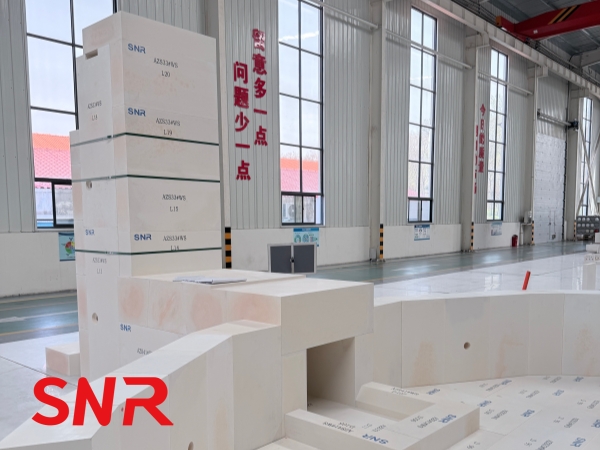

Void-free casting (WS) or end casting (ZWS) technologies are also adopted to accurately control shrinkage cavity location and size. After casting, shrinkage cavity areas are removed through precision machining, increasing the effective usable volume of the refractory blocks by approximately 15% and minimizing weak points vulnerable to corrosion. Meanwhile, the annealing process is optimized through precise step-by-step long-cycle annealing curves, eliminating residual internal stress and improving thermal shock resistance. This significantly reduces the risks of cracking and spalling under frequent thermal cycling conditions.
Strict control of physical and chemical properties is also maintained, ensuring bulk density reaches 3.7–3.9 g/cm³ and apparent porosity remains ≤1.5%, further enhancing corrosion resistance and impermeability.
To address new challenges brought by the electrification trend in the glass industry, the electrical resistivity performance of fused cast AZS blocks is also continuously optimized. Through formulation adjustments, the refractory can maintain relatively high resistivity even after Na⁺ penetration, reducing the risks of electrical conductivity increase and stray current leakage in electrode areas. This helps minimize accelerated corrosion and glass leakage caused by resistivity reduction, making the materials suitable for electric boosting furnaces and ensuring long-term stable operation of the throat under high-temperature and strong electric-field environments.
3. Long-Term Maintenance: Scientific Life Cycle Management for Extended Furnace Throat Service Life
While structural innovation and material upgrades provide the foundation for long-term furnace throat operation, scientific life cycle maintenance is the key to extending service life and reducing maintenance costs. Based on the characteristics of fused cast AZS blocks, a comprehensive maintenance system integrating “precise diagnosis – targeted maintenance – long-term management” can be established to provide professional maintenance guidance for glass manufacturers, enabling dynamic control of throat operating conditions and maximizing the value of refractory products.
In terms of routine inspection and precise diagnosis, glass manufacturers are advised to establish a regular inspection mechanism using a combination of infrared thermal imaging and endoscopic inspection. Surface temperature, corrosion conditions, and refractory status inside the throat can thus be monitored periodically. Infrared thermal imaging can identify abnormal temperature zones on the furnace surface, providing references for evaluating internal corrosion conditions, while endoscopes allow direct observation of spalling, cracking, and molten glass leakage inside the furnace, enabling accurate positioning of damaged areas and providing data support for subsequent maintenance planning.
At the same time, operational parameters such as glass composition, flow velocity, and temperature should be analyzed to evaluate their influence on refractory corrosion. This allows corrosion trends to be predicted in advance and targeted maintenance plans to be developed accordingly.
Regarding targeted maintenance and repair, differentiated solutions should be adopted according to the degree of damage identified during inspection. For areas with minor localized corrosion or spalling, prefabricated fused cast AZS blocks can be fixed using high-temperature bonding agents capable of withstanding temperatures above 1600°C and possessing thermal expansion coefficients compatible with the original refractory materials, thereby preventing cracking caused by thermal mismatch.
For gaps created by erosion, specially formulated high-alumina castables reinforced with wear-resistant aggregates can be used as filling materials, improving abrasion resistance and corrosion resistance while reducing erosion rates by approximately 60% compared with conventional materials. For irregular damaged areas such as corners and joints, plastic refractory ramming materials can be applied due to their excellent adaptability to complex surfaces. After high-temperature sintering, these materials form a dense and high-strength integral structure, helping reduce material leakage and further erosion. During maintenance operations, strict control of installation procedures is essential to ensure seamless integration between repair materials and the original fused cast AZS blocks, avoiding the formation of new stress concentration points.
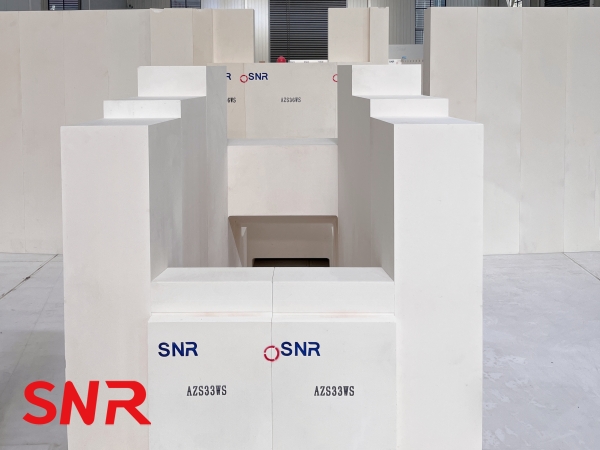
In terms of failure prediction and service life warning, the industry is gradually moving beyond the traditional “passive maintenance” model toward a “corrosion-mechanism-based life prediction service” concept. By continuously monitoring furnace operating data and refractory corrosion conditions, combined with corrosion mechanism analysis, a multidimensional failure assessment system can be established.
For example, erosion pattern morphology can be used to evaluate operating conditions: fish-scale-shaped erosion generally indicates normal wear and usually does not require excessive intervention, while V-shaped groove erosion may indicate structural design defects or excessive molten glass flow velocity, requiring process adjustments or structural optimization. At the same time, precise corrosion rate models can be established. Under soda-lime glass operating conditions, the corrosion front of AZS-41# fused cast AZS blocks typically progresses at a rate of approximately 0.5–0.8 mm per month. When the monitored corrosion rate exceeds 1.2 mm/month, a service life warning can be triggered automatically, accompanied by targeted maintenance or replacement recommendations to help manufacturers avoid unexpected furnace shutdowns and achieve more precise operational control and cost reduction.
For long-term operational management and service life extension, glass manufacturers are encouraged to optimize production process parameters by reasonably controlling molten glass temperature and flow velocity to reduce erosion impact on refractory materials. Cooling systems should also be inspected and maintained regularly, with cooling air temperature and airflow carefully adjusted to ensure stable and uniform cooling performance while minimizing refractory damage caused by improper cooling. The principle of “stable cooling and thermal shock prevention” should always be followed by strictly controlling the temperature gradient between cooling media and refractory surfaces.

In addition, it is recommended to establish detailed refractory service records documenting installation dates, operating conditions, and maintenance history. Based on corrosion behavior analysis, scientifically planned replacement cycles can then be developed to avoid unnecessary replacement costs while reducing safety risks associated with refractory aging. Professional technical training should also be provided to help furnace operators master throat maintenance techniques and emergency response procedures, enabling rapid action in situations such as abnormal furnace pressure or excessive harmful gas concentrations to prevent safety incidents.
4. Differentiated Selection for Furnace Throat Zones: Precise Matching for Maximum Service Value
Different sections of the furnace throat operate under significantly different conditions, including varying corrosion intensity, stress distribution, and thermal shock exposure. Therefore, a single refractory grade cannot satisfy the long-term operational requirements of all throat areas. Based on the specific service conditions of each zone, a differentiated refractory selection strategy should be adopted to achieve precise matching between materials and operating environments while balancing reliability and cost efficiency.
Throat Cover Blocks (Most Severe Operating Conditions)
These blocks are continuously exposed to high-temperature radiation, molten glass splashing, and severe thermal stress. Ultra-high-density AZS-41# void-free fused cast AZS blocks are recommended, with apparent porosity controlled at ≤1.5% and glass corrosion depth limited to ≤0.8 mm/24 h. Additional zirconia protective layers can also be applied to further improve erosion and corrosion resistance, thereby extending replacement intervals.
Throat Sidewall Blocks (Moderate Erosion Conditions)
Sidewall blocks mainly experience lateral molten glass erosion with moderate corrosion intensity. Standard AZS-41# end casting fused cast AZS blocks are recommended to balance corrosion resistance, thermal shock resistance, installation convenience, and economic efficiency for long-term stable operation.
Throat Bottom Blocks (Deposition and Penetration Conditions)
Due to the gravitational effect of molten glass, throat bottom areas are prone to molten glass penetration and impurity deposition. AZS-36# fused cast AZS blocks or high-chrome refractories can be selected according to production requirements. AZS-36# provides a balance between penetration resistance and cost efficiency, while high-chrome refractories offer superior resistance against deposition and corrosion under harsher operating conditions.
Throat Outlet Corners (Combined Thermal Shock and Erosion Conditions)
These areas are simultaneously exposed to high-velocity molten glass erosion and frequent thermal shock, making them highly susceptible to cracking and spalling. A combined solution using AZS-41# fused cast AZS blocks together with zirconia-mullite composite blocks is recommended. The excellent corrosion resistance of AZS-41# and the superior thermal shock resistance of zirconia-mullite materials work together to provide comprehensive protection under these complex operating conditions.
5. Collaborative Optimization: A Three-in-One Strategy for Maximum Value
The long-term stable operation of a furnace throat cannot be achieved through the optimization of a single factor such as structural design, refractory materials, or maintenance practices. Instead, it relies on the systematic coordination of all three dimensions.
Structural innovation improves stress distribution and optimizes molten glass flow behavior, reducing localized high-velocity erosion and creating favorable conditions for refractory performance. High-performance fused cast AZS blocks provide the necessary material foundation to ensure structural reliability under severe operating conditions. Scientific lifecycle maintenance further slows corrosion progression and extends service life.
Together, these three elements form an integrated system in which structural design, material performance, and maintenance strategy mutually reinforce one another, creating a true “closed-loop” optimization model.
From an engineering perspective, long-term furnace throat stability is ultimately the result of system-level coordination rather than isolated improvements in any single aspect.
Conclusion
The performance and service life of a furnace throat are determined by the combined effect of structural design, refractory material quality, and operational maintenance strategy.
A scientifically optimized structure reduces erosion risks, advanced fused cast AZS materials ensure long-term chemical and mechanical stability, and systematic maintenance practices extend overall campaign life.
Only through the integration of these three elements can glass manufacturers achieve stable furnace operation, improved production efficiency, and consistent glass quality over the full lifecycle of the furnace.
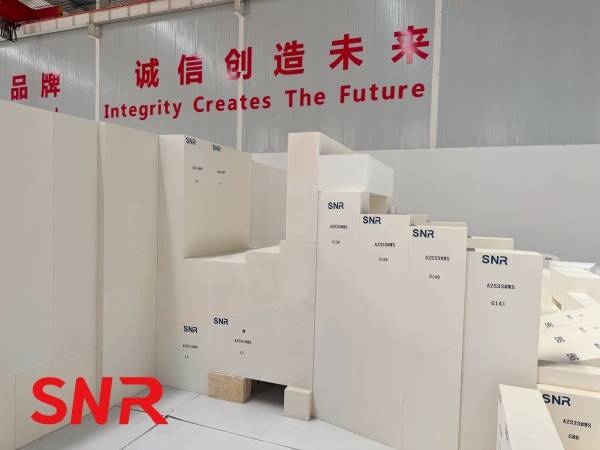
Technical Support
For further technical information regarding furnace throat design optimization and the application of fused cast AZS blocks in glass furnace critical zones, please contact:
 Email: [email protected]
Website: www.snrefractory.com
